Your workout space should work with your routine, not against it. Home gym mirrors can help you monitor form, follow movement patterns, and stay aware of your position while exercising. They may also improve the look and feel of a garage, bedroom, basement, studio, or dedicated fitness room. The challenge is choosing a mirror that fits both your workouts and your wall. Size, thickness, clarity, safety backing, seams, mounting hardware, and lighting all matter. This guide explains how to compare mirror types, estimate costs, plan dimensions, choose a reliable supplier, and install your mirror with safety in mind.
Key Takeaways
- Match the mirror to your workout routine: Choose wide glass panels for strength training, full-length mirrors for yoga and dance, or modular designs for multipurpose rooms.
- Prioritize safety and reflection quality: Compare glass thickness, safety backing, polished edges, distortion, mounting hardware, lighting, and wall compatibility before buying.
- Plan measurements and installation carefully: Account for equipment, doors, outlets, baseboards, seams, delivery, and labor, then request a detailed quote for custom mirror work.
What Types of Home Gym Mirrors Are Available?
The right home gym mirror depends on your workouts, available wall space, design preferences, and budget. A strength-training area may need broad coverage around a squat rack, while a yoga, dance, or mobility space may benefit from a tall mirror that shows your full body and range of motion.
You can choose from traditional glass, acrylic, flexible sheets, modular panels, and smart mirrors with built-in technology. Glass usually provides the clearest reflection and a polished appearance, while acrylic and flexible options may be easier to handle. Custom-cut panels can cover an entire wall and fit around outlets, doors, trim, and other obstacles.
Before ordering, consider more than the mirror’s appearance. Think about the exercises you perform, how many people will use the room, where equipment will sit, and how the mirror will be mounted. A professional measurement can help prevent problems with clearance, seams, and wall compatibility. If you need a custom solution, Glass Rescue’s glass services can help you plan a mirror installation for your space.
Wall-mounted glass panels
Wall-mounted glass panels are a strong choice for dedicated home gyms because they provide wide, consistent viewing coverage. A large panel can help you check your alignment during squats, presses, lunges, stretching, and mobility exercises without repeatedly turning your head. It may also make a smaller workout room appear more open.
According to Lumens Depot’s gym mirror guide, glass panels create a premium visual effect in residential and commercial fitness spaces. Their clean appearance works well behind weight racks, along cardio walls, or across a form-checking area.
Glass panels are heavier than acrylic and require careful handling. Ask a glass professional about panel thickness, safety backing, polished edges, wall supports, and installation. Accurate measurements are especially important when the mirror must fit around baseboards, windows, outlets, doors, or uneven walls.
Full-length framed and frameless mirrors
Full-length mirrors are useful for workouts that involve standing movements, footwork, stretching, dance, balance, or mobility. They allow you to see your body from head to toe, making it easier to review posture, knee alignment, arm position, and foot placement. A framed mirror can also add visual definition to a traditional or decorative room.
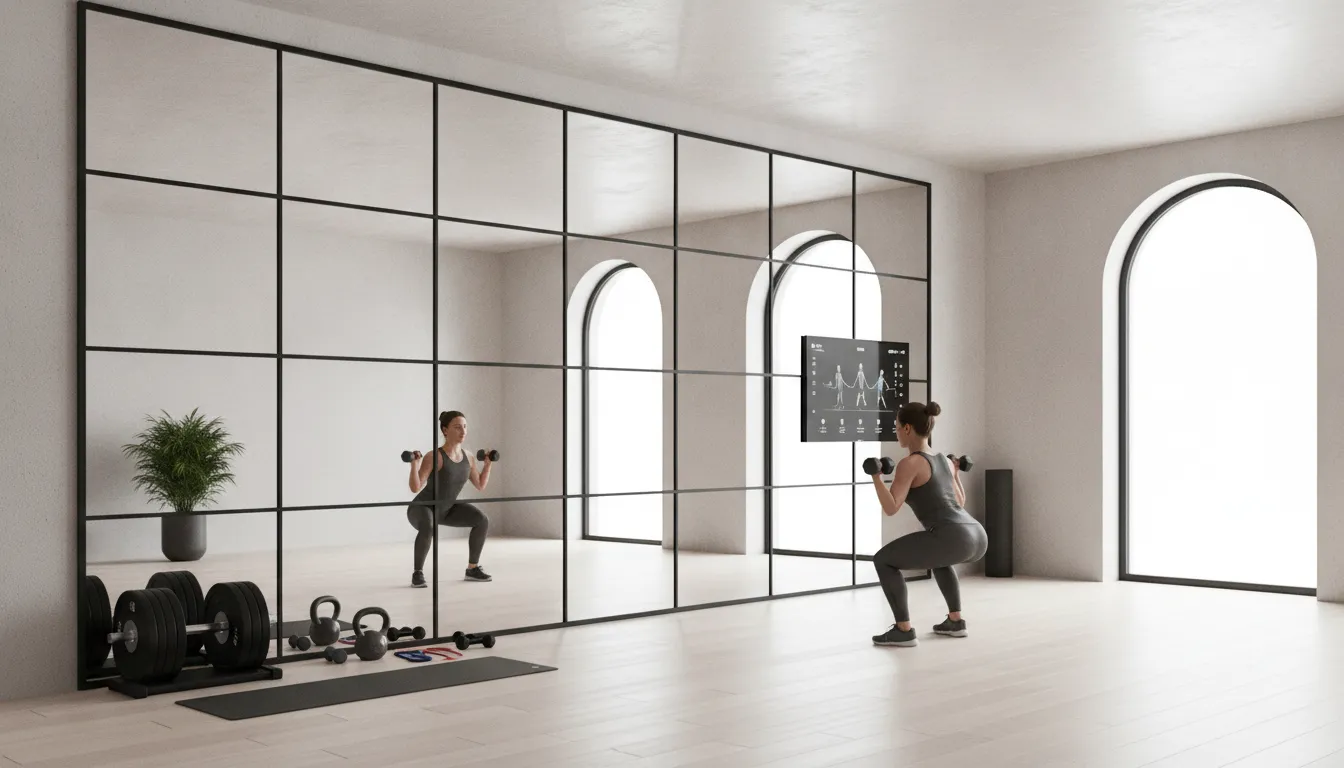
Frameless mirrors create a simpler, more continuous look. When several panels are placed side by side, the smaller borders can reduce visual interruptions across the wall. This style works well in minimalist home gyms, studios, and rooms where you want the mirror to blend into the surrounding design.
A mirror can influence how the room feels as well as how you train. Modern Mirrors explains that a well-placed mirror can make a workout space feel larger and more focused. Choose framed glass when the border complements your decor, or choose frameless glass when uninterrupted reflection matters most.
Modular and custom-cut mirror walls
Modular mirror walls use multiple panels to cover a broad area. This approach works well in garages, basements, wide home gyms, and rooms with more than one workout zone. Separate panels may also be easier to position around windows, columns, outlets, and equipment than one oversized mirror.
With careful planning, several panels can create a nearly continuous reflective wall. Lumens Depot’s guide notes that combining gym mirrors can improve visibility across larger facilities. The same idea applies to spacious residential workout rooms where users need to see their movements from different positions.
Custom-cut mirrors provide even more flexibility. A glass company can account for baseboards, sloped ceilings, unusual wall dimensions, and equipment clearances before fabrication. When comparing options, ask about safety backing, panel thickness, polished edges, seam placement, delivery, and installation.
Acrylic and flexible mirror sheets
Acrylic and flexible mirror sheets are lightweight alternatives to traditional glass. They may be easier to carry and install, which can make them suitable for rental homes, temporary workout spaces, upper-floor rooms, or walls that cannot support heavy materials. Flexible sheets may also work on certain curved or uneven surfaces.
The main trade-off is reflection quality. Depending on the product and the surface beneath it, acrylic may show more waviness or distortion than high-quality glass. It can also scratch more easily, so follow the manufacturer’s cleaning instructions and keep the surface away from barbells, dumbbells, and other equipment that could cause damage.
Some flexible mirror products have less shatter risk than glass, as discussed in this home gym mirror discussion on Reddit. However, lightweight materials still need secure mounting. Check the product’s installation requirements, surface limitations, cleaning guidance, and warranty before purchasing.
Smart mirrors with fitness features
Smart mirrors combine a reflective surface with a digital display, camera, speakers, or connected fitness platform. Depending on the model, you may be able to follow instructor-led classes, view workout metrics, join interactive sessions, or receive real-time feedback. These features can suit people who want guided training without adding a large television to the room.
Smart mirrors need more planning than standard glass. You may need a nearby power outlet, reliable internet, adequate ventilation, and enough space for movement tracking. Some systems also charge recurring fees for classes, coaching, or advanced features, so calculate the full cost before choosing one.
Think about how you plan to use the mirror. If your main goal is checking form, a clear glass mirror may offer better value and fewer maintenance concerns. If you prefer guided workouts and connected training, a smart mirror may serve as both a reflective surface and a digital fitness system.
Match mirror types to workouts, rooms, and budgets
Start by identifying the movements you want to see. Strength-training areas often benefit from wide glass coverage near the rack or lifting platform. Yoga, dance, Pilates, and mobility rooms may need tall, full-length mirrors that show your feet, posture, and overhead movements. A multipurpose room may work better with modular panels placed across several activity zones.
Next, assess the room itself. Glass panels suit permanent gyms where reflection quality and appearance are priorities. Acrylic may be practical when weight, handling, or impact concerns affect your decision. Smart mirrors require power, internet access, and a budget that includes possible subscription fees.
Include more than the mirror price when planning your budget. Measure the wall, compare the cost per square foot, and account for fabrication, delivery, mounting hardware, and installation. Garage Gyms’ buying guide identifies standard side-by-side mirrors as a practical balance of size, appearance, cost, and availability. For unusual wall dimensions or a more precise fit, contact Glass Rescue to discuss your workout area and request a quote.
Which Home Gym Mirror Features Should You Compare?
The best home gym mirror is not always the largest or most expensive option. Start by considering how you use the room, then compare glass quality, safety features, coverage, lighting, moisture resistance, and installation requirements. A mirror for weightlifting has different needs than one used for yoga, dance, mobility exercises, or guided classes.
Your wall and workout equipment also affect the finished result. Check the wall structure, nearby outlets, doors, windows, lighting, and available floor space before ordering. If you need a custom size or a multi-panel installation, Glass Rescue’s mirror services can help you plan a practical fit.
1/4-inch glass, clarity, and low distortion
Many studio and home gym mirrors use 1/4-inch-thick, high-clarity glass. This thickness creates a firm, stable surface and helps produce a clean reflection. A clear, low-distortion mirror makes it easier to check posture, alignment, balance, and range of motion during workouts.
Look at how straight lines appear across the reflection. Wavy edges, stretched images, or uneven areas can make your body position and equipment placement look inaccurate. These issues are especially distracting during squats, deadlifts, stretches, and dance movements.
Ask for product specifications before ordering, particularly if you plan to cover an entire wall. A supplier familiar with fitness spaces can recommend suitable glass and panel sizes. High-clarity gym mirrors are designed for rooms where users need a dependable reflection while moving.
Safety backing, protective film, and polished edges
A safety backing film helps hold the glass together if a mirror cracks. It can reduce the spread of loose shards, which is particularly helpful in an active workout area with weights, benches, racks, and other equipment. Protective film does not make glass unbreakable, so placement and installation still matter.
Polished edges are another feature worth checking. Smooth edges make large panels safer for installers to handle and give the finished wall a cleaner appearance. Ask whether the mirror includes safety backing, polished edges, and hardware rated for its size and weight.
Keep mirrors away from places where dumbbells may fall or barbells may swing. For large panels or several connected sections, professional mirror installation can help ensure the glass is handled and supported correctly.
Reflective coverage, seamless joins, and finish quality
A small workout corner may only need one full-length mirror. Larger strength, dance, or mobility areas often work better with multiple panels that cover a wider section of the wall. Properly measured panels can create broad reflective coverage while keeping seams consistent and unobtrusive.
Inspect the joins before installation. Uneven gaps can interrupt your view, collect dust, and make the wall look unfinished. Level placement, consistent spacing, and clean edges create a more polished result. Check the surface for scratches, dark spots, discoloration, and silvering issues before the panels are mounted.
Plan panel locations around racks, benches, and open movement areas. A gym mirror wall designed around your workout zones can provide better visibility without adding unnecessary seams.
Lighting, glare control, and visibility
Mirrors reflect natural and artificial light, which can make a workout room feel brighter and more open. However, a light aimed directly at the glass may create glare and make your reflection difficult to see. Think about lighting placement before choosing the mirror’s location.
Wall sconces or adjustable fixtures placed beside the mirror often provide clearer visibility than bright lights positioned directly in front of it. Nearby surfaces with a matte finish can also reduce distracting reflections. Keep screens and overhead fixtures in mind, since they may appear in the mirror and compete for your attention.
Observe the room at different times of day if it has windows. Direct sunlight may create glare in the afternoon even if the mirror looks clear in the morning. This exercise room mirror guidance can help you plan placement around light and visibility.
Moisture resistance and wall compatibility
The wall must be strong enough for the mirror and compatible with the mounting system. Drywall, concrete, masonry, wood, and tile may require different anchors, clips, channels, or adhesives. A large glass panel can be heavy, so standard hardware may not provide sufficient support.
Moisture is also important in gyms near bathrooms, pools, laundry rooms, or humid garages. Keep water from collecting along the bottom edge, and confirm that the wall is flat, clean, dry, and structurally sound before installation. The right materials and mounting method can help protect the mirror and the wall over time.
Ask whether your project requires a sturdy wall base or commercial-grade hardware. This mirror wall installation guide explains why wall construction and support should be reviewed before fabrication. A professional assessment is a sensible step when the wall condition is uncertain.
Acrylic and flexible mirror trade-offs
Acrylic and flexible mirror sheets are lighter than glass and generally have less risk of shattering. They may suit a rental, children’s room, temporary workout area, or wall that cannot support heavy panels. Their lower weight can also make transport and handling easier for a small DIY project.
The main trade-off is reflection quality. Flexible materials may show waves, bends, or distortion, especially across a wide surface or on a wall that is not completely flat. Acrylic can also scratch more easily than glass and may have a less refined appearance in a permanent home gym.
Consider your priority before choosing. Acrylic may be practical when weight and handling are the main concerns. For accurate form checks, a durable finish, and broad wall coverage, high-quality glass is usually the better fit. Compare cleaning instructions, mounting options, expected lifespan, and replacement availability.
Smart displays, cameras, audio, and subscriptions
Smart mirrors combine a reflective surface with features such as guided classes, touch controls, speakers, cameras, and workout tracking. They may suit people who want instructor-led sessions without adding a separate television or tablet to the room.
Compare the full ownership cost, not just the purchase price. Some systems charge recurring fees for classes, coaching, progress tracking, or connected features. Check whether the camera includes a physical privacy cover, how personal data is handled, and whether the system connects with your preferred phone or fitness platform.
Placement affects performance too. Smart mirrors may need an outlet, reliable internet, and enough space for cameras and speakers to work properly. Keep cords away from walkways and equipment. If you prefer a simple setup without software updates or subscription fees, a professionally installed glass mirror may be the more practical choice.
How Should You Size Home Gym Mirrors?
Sizing home gym mirrors involves more than measuring an empty wall. You need enough reflective coverage to see your full body during movement, while leaving room for doors, outlets, equipment, and secure installation hardware. A thoughtful layout helps you check your form without making the room feel crowded or difficult to use.
Before ordering, measure the wall width, ceiling height, and floor clearance. Mark the location of racks, benches, treadmills, mats, windows, and other fixed features. These details will help you decide whether one large panel or several smaller panels will work best. For a precise fit, Glass Rescue’s glass and mirror services can account for wall conditions, panel dimensions, polished edges, and seams.
Measure wall width, ceiling height, and floor clearance
Begin by measuring the wall from side to side, then measure from the finished floor to the ceiling. Take measurements at several points because floors, ceilings, and walls are not always perfectly level. Record the location of baseboards, trim, windows, doors, outlets, switches, vents, and light fixtures that could affect the installation.
Next, decide how much wall you want to cover. A single mirror may suit a compact workout area, while multiple panels can create wider coverage for strength training, dance, or group exercise. Leave enough room for equipment and movement, particularly if you use adjustable benches, power racks, pull-up bars, or free weights near the wall.
Large gym mirrors are often bonded to the wall, so careful planning matters before fabrication. Measuring the wall and surrounding features in advance can help prevent gaps, awkward cutouts, and installation problems.
Cover full-body movement, feet, and overhead range
Your mirror should show more than your torso. For squats, lunges, yoga, dance, and overhead presses, you need to see your feet, knees, hips, shoulders, and hands throughout the movement. Check the reflection from the position where you will actually exercise, not only from the center of the room.
A mirror can often begin about 18 inches above the floor and still show a user’s feet, head, and raised arms. Your ideal starting height depends on your height, workout style, and viewing distance. Floor-based exercises may call for a smaller floor gap, while standing workouts require enough height to capture your overhead range. Use the recommended mirror placement guidelines as a starting point, then adjust the layout to suit your routine.
Plan 48- to 72-inch mirror heights and floor gaps
Home gym mirrors are commonly planned at heights between 48 and 72 inches. A mirror shorter than 48 inches may not show enough of the body for many standing exercises. For example, a 60-inch mirror installed 18 inches above the floor reaches 78 inches high, which can accommodate many users during upright workouts.
Treat these measurements as practical guidelines, not fixed rules. Taller users may need more height, while a compact room may require shorter panels. Measure from the finished floor, including rubber flooring, mats, or other surfaces that will stay in place. If you plan to install gym flooring later, include its thickness before finalizing the mirror position.
The right floor gap also depends on safety and cleaning access. A small gap can make the mirror feel more continuous, but a slightly larger gap may work better around baseboards or uneven flooring. A local glass professional can help confirm the dimensions before the glass is cut.
Position mirrors around equipment and workout zones
Plan the mirror around the way you use each part of the room. A mirror beside a squat rack can help you check bar position, knee tracking, and body alignment. A mirror facing a mat may be more useful for yoga, mobility work, stretching, or floor exercises. For treadmills and other cardio machines, position the mirror where you can review your posture without creating a distracting reflection.
Avoid placing a mirror where a barbell, dumbbell, kettlebell, or moving machine could strike it. Leave practical space around racks and benches, and consider how equipment will be carried into and out of the room. The workout zones in your gym should guide the mirror layout, rather than the other way around.
If your gym has several activity areas, two strategically placed mirror sections may work better than one oversized panel. This approach can improve visibility across the room and make future repairs or replacements more manageable.
Account for viewing angles and multiple users
Stand in each position where you expect to exercise and check what the mirror will reflect. A panel that works from the center of the room may provide limited visibility from a corner or beside a machine. Decide whether you need a front view, a side view, or both. Two perpendicular mirror walls can provide useful feedback for strength training, dance, and movement practice.
If several people use the gym, plan for the shortest and tallest users. The mirror should offer clear coverage without forcing anyone to stand in an awkward position. Wider panels or carefully aligned sections can help multiple people exercise at the same time.
Installation quality matters just as much as the measurements. Tilted panels, uneven seams, and inconsistent spacing can make reflections look distorted or interrupt a user’s view. An experienced installer can assess viewing angles, wall conditions, and panel alignment before installation. This is especially important when fitting large or multi-panel mirrors.
Check doors, outlets, windows, baseboards, and seams
Inspect the entire wall before choosing a final mirror size. A door may swing into the planned panel, while a window, outlet, light switch, or wall vent may require a cutout or a different layout. Baseboards and uneven trim can also prevent the mirror from sitting flush against the wall.
Plan seams where they will be least distracting and least likely to interfere with your view. For example, align seams with natural breaks between workout zones or equipment sections. Do not cover electrical fixtures without confirming that they can remain accessible for maintenance.
Also check whether the wall is made from drywall, concrete block, brick, or another material. The surface can affect the mounting method and installation timeline. Mention damaged drywall, unusual trim, moisture exposure, or narrow access points when requesting a quote. Glass Rescue offers custom mirror solutions for residential and commercial spaces, helping homeowners plan panels around existing features while keeping the finished installation clean and functional.
How Much Do Home Gym Mirrors Cost?
The cost of a home gym mirror depends on more than the reflective surface. Size, glass thickness, safety backing, edge finishing, fabrication, delivery, and installation can all affect the final project price. A small acrylic mirror may suit a compact workout corner, while a wall of custom-cut glass requires careful measurement and professional handling.
Start by deciding how much wall coverage you need and how you plan to use the space. A mirror for checking dumbbell form has different requirements than one used for dance, yoga, mobility work, or full-body training. Glass Rescue’s glass services can help you compare custom mirror options based on your room, workout setup, and installation needs.
Entry-level acrylic, standard glass, and mirror kits
Acrylic mirrors, standard vanity mirrors, and ready-made mirror kits are generally the most affordable options. They can work well in small home gyms, garage workout areas, and rental spaces where a lightweight product is easier to handle. Some homeowners also reduce material costs by purchasing used mirrors or repurposing mirrored closet doors.
Acrylic is lighter and less fragile than glass, but it can scratch more easily and may show slight distortion across larger surfaces. Standard glass usually offers a clearer reflection for checking form. Your choice depends on your budget, wall space, and installation plans. Garage Gyms compares home gym mirror options, including affordable vanity mirrors and secondhand products.
Custom panels, thicker glass, and premium finishes
Custom mirror panels typically cost more because they are measured, cut, finished, and prepared for a specific wall. You may also pay more for thicker glass, safety backing, polished or beveled edges, tinted finishes, and unusual shapes. These features can create a cleaner appearance and provide added protection in a busy workout area.
As a general reference, safety-glass mirrors designed for gyms and dance studios may cost about $300 for a 36-by-60-inch panel and about $400 for a 48-by-84-inch panel, before delivery or installation. Exact pricing varies by supplier, material, and location. A local fabricator such as Glass Rescue can discuss panel dimensions, edge treatment, and wall conditions before preparing a quote.
Smart mirror hardware, software, and subscriptions
Smart mirrors usually cost more than traditional glass because they combine a reflective surface with a display, speakers, cameras, sensors, and software. Depending on the model, features may include guided classes, performance tracking, interactive coaching, and access to live or on-demand workouts.
The purchase price may not be the only expense. Some systems require a monthly or annual subscription for workout content, progress tracking, or connected features. Compare the equipment cost, membership terms, warranty, replacement policy, and internet requirements before buying. Modern Mirrors explains smart home gym mirror features, but confirm current pricing and subscription details with each manufacturer.
Compare price per square foot with total project cost
Price per square foot helps you compare mirrors of different sizes, but it does not show the full project cost. A low-priced panel may require expensive delivery, specialized mounting hardware, edge finishing, or professional installation. A higher-priced custom mirror may provide better coverage with fewer seams and less adjustment during installation.
Ask each supplier for an itemized estimate that separates the mirror, fabrication, safety backing, hardware, delivery, measurement, and installation. Confirm whether the quote includes tax, wall preparation, cleanup, and removal of existing mirrors. The most useful comparison is the total cost of a finished installation, not just the listed price of the glass.
Consider size, material quality, brand, and fabrication
Larger mirrors usually cost more, but size is only one factor. A clear, well-fabricated mirror with minimal distortion may be more useful than several inexpensive panels that create uneven reflections. Glass quality, protective backing, edge treatment, fabrication standards, and the supplier’s experience can affect how the mirror performs over time.
Very inexpensive hanging door mirrors may seem convenient, but they often provide limited coverage for movement-based workouts. Affordable vanity mirrors from home improvement stores can offer a better balance of size, appearance, and availability. For a custom wall, ask how the mirror will be cut and finished, and whether it is appropriate for a space where weights or equipment could cause accidental impact.
Include delivery, measurement, and installation charges
Large mirrors can be difficult to transport and install safely. Delivery may require specialized handling, especially when the project includes multiple panels, narrow staircases, elevators, or long distances. Professional measurement also helps prevent problems around outlets, baseboards, doors, windows, and uneven walls.
Installation charges depend on the mirror’s size, wall material, number of seams, mounting system, and site access. Some suppliers offer delivery and installation within a defined service area, while others ship the mirror and leave installation to the buyer. Mirrors Delivered outlines delivery and installation considerations, so review these services before comparing estimates.
Compare quotes, warranties, replacements, and promotions
Request two or three quotes for a custom project, but do not compare the totals alone. Make sure each company is quoting the same mirror size, thickness, backing, edge finish, mounting hardware, and installation method. A lower estimate may leave out measurement, delivery, wall preparation, or cleanup.
Ask whether the warranty covers manufacturing defects, installation issues, and hardware. Find out how the company handles cracked or damaged panels, too. Replacing one section is often easier and less expensive than replacing an entire mirror wall, especially when panels were custom-fabricated. Local companies may also be easier to contact if you need a replacement or adjustment. Glass Rescue’s contact page is a useful place to discuss measurements, service areas, and project details.
Prioritize coverage on a limited budget
If your budget is limited, mirror the areas where you need to see your full body during exercise. You may not need coverage on every wall. One wide panel beside a rack, mat, or lifting zone can provide useful form feedback without the cost of a full-room installation.
Secondhand mirrors and mirrored closet doors may lower material costs, but inspect them for chips, scratches, distortion, and weak backing. Flexible mirror sheets can be easier to move, although product quality and clarity vary. For many home gyms, side-by-side vanity mirrors from a home improvement store offer a practical balance of price, coverage, and availability. Custom panels make more sense when you need a precise fit, polished edges, and a more seamless appearance.
Which Home Gym Mirrors Fit Different Spaces and Workouts?
The best home gym mirror depends on how you train, how much wall space you have, and how much impact the mirror may face. A weightlifting area has different needs than a yoga corner, while a garage may require a different material than a climate-controlled bedroom.
Start by identifying the movements you need to see clearly. Strength training usually calls for a durable, full-body view that helps you check alignment. Yoga, dance, and mobility work benefit from broad coverage, especially when you need to watch your arms, legs, and posture at the same time. Cardio rooms may need several panels to reduce blind spots as you move around the space.
Room conditions matter, too. Measure the wall, check the ceiling height, and look for doors, windows, outlets, baseboards, and equipment that could interfere with installation. You should also consider where people will stand, how much clearance equipment needs, and whether the mirror will face direct sunlight or bright lights.
A professional installer can help match the mirror’s size, mounting method, and finish to the wall. For custom sizing and installation, Glass Rescue’s mirror services can help you plan a mirror that fits your room instead of forcing a standard product into an awkward space. The right choice should provide a clear reflection, secure mounting, and enough coverage for the movements you perform most often.
Strength and free-weight zones
Strength areas need mirrors that show your full body from several angles. A wall-mounted glass panel or a series of large, frameless panels can help you check your spine, knees, hips, shoulders, and grip while lifting. Real-time visual feedback can make it easier to correct form and identify movement patterns that may contribute to injury, as explained in this guide to mirrors and workout posture.
Position the mirror where you can see yourself without stepping into the path of a barbell, dumbbell, or kettlebell. Keep enough space between the glass and your equipment to reduce the chance of impact. Safety backing or protective film is also worth considering, particularly in a busy weight room. If you lift with a partner, use enough mirror width for both people to view their form without crowding one another.
Yoga, dance, mobility, and form-checking areas
Yoga, dance, Pilates, and mobility exercises require a clear view of the body in motion. Full-length frameless mirrors work well because they provide an uninterrupted reflection from floor to ceiling. If the room is narrow, install panels across the longest practical wall to give yourself more useful viewing space.
For these workouts, mirror placement may matter more than having the largest possible panel. Place the mirror where you can observe your feet, hands, hips, and shoulders during floor-based and standing movements. A clean, low-distortion reflection makes small alignment changes easier to spot. Mirrors can also make a compact practice area feel brighter and more open, helping create a focused workout environment. This home gym mirror guide explains how reflective surfaces can change the feel of a workout room.
Cardio and multipurpose fitness rooms
Treadmills, bikes, rowing machines, and open workout areas often require broader mirror coverage than a single exercise station. Modular mirror panels can cover more wall area while allowing you to work around windows, doors, and built-in storage. Side-by-side panels can also provide useful viewing angles when people move across the room.
For a multipurpose space, place mirrors on the walls that face the main activity zones. Avoid positioning them where direct sunlight or bright overhead fixtures create glare. If the room serves several users at once, wider coverage can help everyone check their movement without turning toward another person’s station. Large gym mirrors can also create a more spacious visual effect and support a polished workout setting, according to this guide to gym mirrors for home and commercial spaces.
Small bedrooms, apartments, and low-ceiling rooms
In a bedroom, apartment, or low-ceiling room, the mirror needs to provide useful coverage without overwhelming the space. A vertically oriented full-length mirror can support basic form checks while preserving wall area for shelving, artwork, or storage. If you have a wider workout zone, two or more narrow panels may fit better than one oversized sheet.
Mirrors can reflect natural and artificial light, making a small room feel brighter and more inviting. Place the mirror across from a window or light source when possible, but check the reflection at different times of day to avoid glare. Frameless panels usually create a clean look and can make seams less noticeable.
Before ordering, account for baseboards, closet doors, outlets, and the floor gap needed for installation. In a low-ceiling room, confirm that the mirror will show your full body without colliding with light fixtures or shelves. This exercise room mirror guide offers additional planning ideas for compact spaces.
Garages, basements, and moisture-prone spaces
Garages and basements can expose mirrors to temperature changes, humidity, dust, and accidental contact with equipment. For these rooms, consider the wall condition and moisture level before choosing glass. A professional can check whether the surface is clean, dry, flat, and suitable for adhesive or mechanical mounting.
Flexible mirror sheets may be lighter and less likely to shatter than traditional glass, which can be helpful in a garage gym. However, they may show more visual distortion, especially across larger areas. Glass often provides a clearer reflection, but it requires careful handling and secure installation.
Keep any mirror away from areas where weights may strike the wall, and resolve leaks or persistent condensation before installation. You should also make sure the mounting system suits concrete, block, brick, or finished drywall. Compare the practical differences between materials in this garage gym mirror guide.
Residential gyms, studios, offices, and commercial fitness rooms
Residential gyms often benefit from custom mirror walls that fit the room’s exact dimensions. A home studio may need full-body coverage for classes, while an office fitness room may need a durable, professional finish that works around doors, columns, and storage. In each case, the mirror layout should match the activities and number of users.
Commercial spaces typically need more planning than a single home workout room. Consider high-traffic areas, cleaning routines, wall construction, lighting, and the risk of contact with equipment. Side-by-side glass panels can provide broad coverage, while custom cuts help accommodate outlets, trim, corners, and architectural features.
For a studio or business, professional measurement and installation can reduce gaps, uneven seams, and mounting problems. Glass Rescue’s commercial glass experience includes large-scale projects such as storefronts and partition walls, making a consultation useful when your fitness room requires a precise, durable installation. A detailed plan can also help you coordinate mirror placement with flooring, lighting, racks, and other equipment.
Where Can You Buy Home Gym Mirrors?
The best place to buy a home gym mirror depends on your room, workout style, budget, and installation plans. A standard full-length mirror may suit a small bedroom gym, while a wall of custom-cut glass can provide better coverage for strength training, yoga, dance, or a shared fitness room.
Home improvement stores and online marketplaces offer convenient, ready-to-ship options. Local glass companies can provide more flexibility when your wall has unusual dimensions, outlets, doors, baseboards, or uneven sections. Custom fabrication may cost more upfront, but it can reduce visible seams and help you choose the right mounting method.
Before ordering, compare more than the listed price. Check the glass thickness, clarity, safety backing, dimensions, delivery process, hardware, and installation support. A low-priced mirror may cost more if it arrives damaged, does not fit the wall, or requires additional equipment and labor.
It also helps to decide how much coverage you need. One mirror may be enough for checking form during strength workouts, while multiple panels can serve a larger movement area. Measure first, request detailed quotes, and confirm the seller’s replacement policy before committing to a purchase.
Order custom mirrors from Glass Rescue
A custom mirror can give your workout space a cleaner fit than several standard mirrors placed side by side. Glass Rescue can help with mirror dimensions, custom cuts, polished edges, and installation details for residential and commercial projects. This option works well when your wall includes outlets, windows, doors, baseboards, or other obstacles.
Discuss your workout zones before ordering. A weightlifting area may need durable coverage behind a rack, while a yoga or dance area may benefit from a wider, uninterrupted reflection. The team can also help you consider panel placement, seams, and wall conditions. Review Glass Rescue’s glass and mirror services to learn more about options for your space.
Shop online marketplaces and home improvement stores
Online marketplaces and home improvement stores offer a convenient starting point when you need one or two standard-size mirrors. Retailers such as Home Depot and Lowe’s often carry full-length mirrors, vanity mirrors, closet-door mirrors, framed designs, and basic mounting hardware. These products can work well for renters, small home gyms, and buyers who prefer ready-to-ship items.
You may also find returned products, discontinued styles, or slightly damaged mirrors at reduced prices. Inspect these items carefully before buying, since chips, scratches, and reflection distortion can become distracting during workouts. Confirm the current dimensions, shipping method, return policy, and installation options. If you are purchasing online, check how the seller handles damage claims for large or fragile deliveries.
Contact local glass companies and fabricators
A local glass company can offer more flexibility than a mass retailer. Fabricators may cut mirrors to fit unusual walls, create multiple panels, polish exposed edges, and recommend mounting systems for drywall, concrete, block, or brick. They may also coordinate delivery and installation, which can simplify a project involving large or heavy panels.
Professional installation usually costs more than a basic DIY setup, but a local quote may be competitive after you include transportation, hardware, and labor. Look for a provider with residential and commercial experience, then ask whether it serves your location. Glass Rescue serves customers throughout Dade and Broward counties, including communities such as Hollywood, and is expanding into Hillsborough County, including the Tampa area.
Compare mirror brands, product lines, and reviews
Do not compare mirrors by size and price alone. Read the product description for glass thickness, backing, edge treatment, clarity, finish, and included hardware. Two mirrors with similar dimensions can look very different if one produces noticeable distortion or has a darker reflective surface.
Product reviews can reveal details that specifications leave out. Look for repeated comments about warped reflections, damaged packaging, difficult mounting, delivery delays, or poor customer support. Also confirm that the seller is active and currently ships to your location. Older listings and outdated reviews may not represent the company’s current products, prices, or service policies.
Use reviews to assess clarity, delivery, and support
Clarity matters when you use a mirror to check posture, alignment, and movement. Read reviews for comments about image quality in bright and dim rooms, visible seams, edge damage, and reflection distortion. A mirror that looks clear in a product photo may reveal flaws under your gym’s lighting.
Pay attention to delivery experiences, too. Large mirrors need careful packaging and handling. Check whether buyers received tracking information, whether the seller helped with damage claims, and how quickly replacement panels or hardware arrived. Reviews that mention clear communication can be just as useful as reviews about the mirror itself. Search for feedback from customers who purchased mirrors of a similar size.
Check warranties, returns, delivery, installation, and replacement policies
Before paying, read the seller’s policies for damaged shipments, returns, defects, and replacements. Some retailers require damage reports within a short period. Custom mirrors may not qualify for returns because they are made to specific dimensions. Ask what happens if the mirror arrives cracked, the size is incorrect, or the hardware is missing.
Confirm whether delivery includes the front door, garage, room, or installation site. For oversized panels, ask whether the crew will carry the mirror indoors. You should also clarify whether installation is included or priced separately. If you are ordering multiple panels, find out whether the company can replace one damaged section without requiring you to purchase the complete set again.
Request itemized quotes and confirm promotions
An itemized quote makes it easier to compare a local fabricator with a retailer or online seller. Ask for separate prices for the mirror, custom cutting, polished edges, safety backing, hardware, delivery, measurement, and installation. This helps identify charges that may not appear in an initial product listing.
Ask about current promotions, package rates, contractor pricing, or discounts for multiple panels. Home improvement stores may have returned vanity mirrors or closet doors available at reduced prices, but inspect their condition before accepting them. For custom work, confirm that the quote includes the exact dimensions, number of panels, finish, edge treatment, and mounting method you discussed.
Confirm measurements, coverage, and mounting before ordering
Measure the wall width, ceiling height, floor clearance, baseboards, outlets, doors, and nearby equipment. Mark the planned mirror area with painter’s tape so you can see how much of your body and workout zone will appear in the reflection. A mirror does not always need to reach the floor to show your feet, legs, and overhead movements, depending on its height and placement.
Before finalizing the order, confirm the mirror’s weight and the wall’s construction. Ask whether the recommended mounting system works with drywall, studs, concrete, block, or brick. Share photos or request a site measurement if the wall has unusual angles or obstacles. Use Glass Rescue’s contact page to request project guidance and an itemized quote.
How Can You Install Home Gym Mirrors?
Installing home gym mirrors takes more planning than placing glass against a wall. You need to confirm the wall condition, choose the right panel layout, and select mounting hardware that suits the mirror’s size and weight. A careful installation creates clear reflections, even seams, and a secure workout area.
Start by identifying the areas that need coverage. A strength-training wall may need full-body visibility around a rack, while a yoga or dance space may benefit from a wider, uninterrupted span. Measure the wall carefully, including baseboards, outlets, windows, doors, ceiling height, and floor clearance. Glass Rescue’s mirror services can help with custom sizing and planning around the room’s layout.
Large mirrors can crack when they are carried, supported, or mounted incorrectly. If you are unsure about the wall material, panel weight, or installation method, ask a professional to review the project before fabrication begins.
Hire professionals for measurement, fabrication, delivery, and installation
A professional mirror installer can manage the process from the first measurement through final cleanup. This is especially helpful when your gym requires multiple panels, narrow seams, unusual angles, or cutouts around outlets and fixtures. Accurate measurements also reduce the risk of ordering mirrors that do not fit the available wall.
Experienced installers know how to transport large sheets without damaging corners, edges, or the reflective backing. They can also identify uneven walls, weak mounting points, moisture damage, and obstructions behind drywall. Guidance on choosing a gym mirror installation company emphasizes the value of experience with large mirror panels, particularly for avoiding alignment and mounting problems.
Professional installation can simplify the project because one team handles fabrication, delivery, and mounting. Before accepting an estimate, ask whether it includes site measurement, delivery, installation, cleanup, and replacement support.
Use mirror mastic on clean, dry, suitable walls
Mirror mastic is an adhesive designed for attaching mirrors to compatible wall surfaces. It can create a clean appearance because there are no clips across the face of the mirror. However, the wall must be clean, dry, stable, and reasonably flat before the adhesive is applied.
Remove dust, grease, loose paint, and debris from the installation area. Repair peeling paint, damaged drywall, and water problems first. Avoid ordinary construction adhesive, since some formulas can damage the mirror backing over time. If the wall is damp or uneven, adhesive alone may not provide a dependable bond.
Placement must be confirmed before applying mastic because large gym mirrors are often permanently bonded to the wall. The ABC Glass and Mirror installation guide recommends using mirror mastic on clean, dry walls and planning the panel layout carefully. Follow the adhesive manufacturer’s curing instructions, and use temporary supports until the mastic has fully set.
Install J-channels, clips, frames, and mechanical supports
Mounting hardware helps support mirror panels and keep them aligned. A bottom J-channel can support the lower edge, while clips, a top channel, or a frame can secure the upper edge. The best combination depends on the mirror’s dimensions, weight, wall material, and the appearance you want.
J-channels provide a straight base for a mirror wall. Clips offer a simpler look with less visible framing, while full frames can protect the edges and create a more finished appearance. Mechanical supports may be particularly important for thick or oversized panels, even when mirror mastic is part of the installation.
Plan hardware locations before lifting the mirror. Mark each channel and clip, confirm that fasteners will reach secure material, and check the layout with a level. A detailed home gym mirror installation plan typically covers panel layout, J-channel placement, clip mounting, and support requirements. Preparing these details in advance helps prevent uneven seams and excess pressure on the glass.
Compare standard and premium channel systems
Channel systems vary in appearance, support, and price. A standard arrangement commonly uses a bottom J-channel with plastic clips near the top. This setup may work well for a simple installation and can help control the overall project cost.
A premium system may include both bottom and top J-channels. Continuous channels create a more finished appearance and provide consistent support along the mirror edges. They can also make several panels look more uniform, particularly when the installation spans an entire wall.
Compare the systems based on the mirror’s size, wall condition, nearby equipment, and frequency of use. A home gym with free weights may benefit from stronger support and additional edge protection. A low-traffic stretching area may be suitable for a simpler arrangement. Mirror installation product guidance can help you compare standard and premium channel systems, but an installer should confirm which hardware suits your specific wall and panel layout.
Match hardware to drywall, studs, concrete, block, or brick
The wall material determines which fasteners and tools you need. For drywall, attach channels or clips to studs whenever possible. If a stud is not available, choose anchors rated for the mirror’s expected load. A lightweight drywall anchor may not be suitable for a large glass panel.
Concrete, block, and brick require masonry anchors and the correct drill bit. Garage and basement walls should also be checked for moisture before mirrors are installed. For concrete surfaces, installation guidance recommends concrete anchors and a suitable masonry drill bit. Always match the anchor to the actual wall material.
Before drilling, check for hidden plumbing, wiring, and other utilities. Walls with tile, furring strips, insulation, or layered construction may require a different approach. If you cannot identify the wall structure, ask a professional to assess it before installation.
Prepare, level, and plan wall seams
Wall preparation affects the mirror’s appearance and stability. Remove loose paint, repair damaged drywall, and address cracks or moisture before beginning. Reflections can make small wall irregularities more noticeable once the panels are installed.
Use a level to establish the installation line, then mark each panel, channel, and clip. If one wall requires several mirrors, plan the seams before ordering. Consistent gaps generally look cleaner than uneven spacing, and a thoughtful layout can keep seams away from the most important viewing areas.
Check how panels will meet corners, baseboards, doors, and adjacent walls. You may need to choose between vertical and horizontal layouts based on the wall dimensions and the mirror sizes available. The ABC Glass and Mirror home gym mirror guide highlights wall selection, leveling, and seam planning as important preparation steps.
Use the right DIY tools and two-person handling
DIY installation may be practical for a small mirror, but large panels require careful preparation. Gather a tape measure, level, drill, suitable bits, fasteners, mirror mastic if needed, protective gloves, eye protection, suction cups, and temporary supports. Read the mounting instructions before starting, and clear the workout area of equipment and other obstacles.
Never carry or position a large mirror alone. A second person can help control the panel, protect the edges, and keep it steady while you secure the hardware. Carry the mirror upright when recommended, avoid pressure on the corners, and place it on a padded surface whenever it is not being mounted.
Glass can crack or shatter if it is twisted, dropped, or struck against a hard surface. DIY gym mirror installation guidance notes the risks involved in handling large panels. Stop if the mirror feels unstable or the mounting points do not align, rather than forcing it into place.
Hire professionals for large, heavy, or multi-panel mirrors
Professional installation is the safer choice for floor-to-ceiling mirrors, thick glass, multi-panel walls, and installations around gym equipment. Large panels require coordinated lifting, accurate positioning, and reliable support while adhesive or hardware is secured. A small error can damage the mirror or leave the entire wall misaligned.
Professional help is also useful in garages, basements, commercial gyms, and rooms with concrete or masonry walls. These spaces may require specialized anchors, extra wall preparation, or solutions for humidity and temperature changes. A local glass company can coordinate fabrication, delivery, and installation instead of leaving you to manage each stage separately.
When requesting an estimate, ask about panel thickness, safety backing, polished edges, mounting hardware, delivery, cleanup, and warranty coverage. Glass Rescue serves residential and commercial customers throughout Dade County, Broward County, Hollywood, Tampa, and surrounding Hillsborough County areas. A consultation can help determine whether your gym needs adhesive mounting, channels, clips, or a combination of methods.
How Can You Install Home Gym Mirrors Safely?
A home gym mirror should help you check your form without creating another hazard. Safe installation starts before the mirror reaches the wall. Consider the glass type, panel size, wall structure, mounting method, room conditions, and equipment placement. A large mirror can be heavy and awkward to handle, while a panel installed too close to weights or moving equipment may be vulnerable to impact.
For the safest result, ask a professional to measure the space, recommend suitable materials, and install the mirror with hardware matched to the wall. This is particularly important for multi-panel designs, concrete or masonry walls, and busy workout areas. A local glass company such as Glass Rescue can help with custom sizing, fabrication, and installation for residential and commercial fitness spaces.
Choose safety-backed, film-backed, or shatter-resistant glass
Standard mirror glass can break into sharp pieces if struck. For a home gym, ask about safety-backed or film-backed mirrors. A protective film helps hold broken glass together, which can reduce the number of loose shards that fall onto the floor. It does not make the mirror unbreakable, so you should still keep weights and equipment away from the panel.
The right option depends on the room and the type of exercise you do. A free-weight area may need more impact protection than a space used for yoga or stretching. Ask your installer about safety-backed products, edge treatments, and other protective options. You can also review examples of safety-backed gym mirrors before requesting an estimate.
Select the right thickness and impact protection
Mirror thickness affects rigidity, handling, and reflection quality. Many gym mirror products use 1/4-inch glass because it offers a sturdy surface and clear reflections. However, the appropriate thickness depends on the panel’s dimensions, support system, wall condition, and the likelihood of contact with equipment.
Tell the installer how you use the room, including whether it contains squat racks, barbells, cable machines, or free weights. They can recommend suitable glass specifications and discuss added protection, such as safety film, polished edges, protective barriers, and safer placement. Do not choose a thickness based only on price or appearance. The glass should suit the entire installation, not just the mirror’s size.
Use studs, anchors, channels, and load-rated hardware
Mirror adhesive may work for some walls, but it is not the right solution for every installation. The wall material and mirror weight determine whether you need studs, anchors, J-channels, clips, or another support system. Drywall, wood framing, concrete, block, and brick require different fasteners and installation methods.
For a concrete basement wall, for example, the installer may use concrete anchors and a masonry drill bit designed for that surface. Hardware should match the mirror’s weight and dimensions, not simply fit an existing hole or channel. Professional gym mirror guidance also recommends matching the mounting hardware to both the wall type and the mirror.
Handle panels with gloves, eye protection, and multiple people
Large mirror panels can be difficult to carry, position, and secure. Wear cut-resistant gloves and eye protection, and clear the route from the delivery area to the installation wall. Never carry a large panel alone if its size or weight makes it difficult to control.
Use multiple people who know how to handle glass, or hire a professional installation team. Keep the panel upright while moving it, protect the corners, and avoid resting it directly on a hard floor. If the mirror arrives with a chip, crack, or damaged edge, do not install it. Set it aside safely and contact the supplier or installer for instructions.
Keep mirrors clear of weights, racks, doors, and walkways
Install the mirror where users can see their full body without standing in a collision zone. Avoid placing it directly behind areas where dumbbells, kettlebells, plates, or bars could be dropped. Racks and machines should have enough clearance to prevent handles, bars, cables, and attachments from striking the glass.
Check nearby doors and walkways, too. A door that swings into the mirror can cause significant damage, and a panel placed beside a narrow passage may create a hazard during busy workouts. Gym mirror placement advice recommends keeping mirrors away from active workout areas where accidental contact is more likely.
Avoid moisture, heat, and electrical fixture conflicts
Choose a stable wall away from persistent moisture, excessive heat, and direct steam. Humidity can affect mirror backing and adhesives over time, especially in rooms with limited ventilation. In garages, basements, and multipurpose rooms, check for leaks, condensation, and major temperature changes before scheduling installation.
Plan around outlets, switches, light fixtures, vents, and wiring. Do not cover electrical access points or install a mirror where it could interfere with future repairs. Mark these features during the measuring appointment, then decide whether the design needs cutouts, gaps, separate panels, or a different wall. This planning is important because many large mirrors are bonded directly to the wall. Home gym mirror planning guidance covers several placement concerns worth reviewing.
Clean mirrors safely and inspect mounts, edges, and seams
Use a soft microfiber cloth and a cleaner approved for mirror glass. Spray the cleaner onto the cloth instead of soaking the mirror, and keep liquid away from edges, seams, clips, channels, and the lower edge. Excess moisture can work behind the glass and damage the backing.
Inspect the installation regularly, particularly after moving heavy equipment or changing the room layout. Look for loose hardware, lifting edges, cracks, chips, dark spots, or movement between panels. Pay close attention to seams, since shifting or widening gaps may indicate a mounting problem. Do not press on damaged glass or try to stabilize a loose panel yourself. Contact the installer for an inspection.
Plan for cracked-mirror replacement and access
Even a carefully installed mirror may need replacement after a major impact. Before installation, ask how an individual panel can be removed and replaced without disturbing the rest of the wall. This is especially important when several panels are installed edge to edge or bonded with adhesive.
Keep the product information, installation notes, and glass specifications with your home records. Ask whether replacement panels can be fabricated to the original dimensions and whether the mounting hardware will remain accessible for maintenance. A design with manageable panel sizes may cost more initially, but it can simplify repairs compared with replacing one oversized sheet. To discuss a durable, serviceable installation, contact Glass Rescue with your wall dimensions, equipment layout, and mirror coverage goals.
Why Choose Glass Rescue for Home Gym Mirrors?
The right home gym mirror does more than make a room feel larger. It gives you a clear view of your form, helps you monitor your range of motion, and makes it easier to use your equipment with confidence. Whether you are lifting weights, practicing yoga, stretching, dancing, or completing at-home cardio, the mirror should support the way you move through the room.
A poor fit can create distracting seams, awkward gaps, and blind spots. The wrong installation may also interfere with outlets, baseboards, doors, lighting, or workout equipment. Glass Rescue helps homeowners, studios, offices, and commercial fitness facilities plan mirror installations around the dimensions and purpose of each space.
With more than two decades of experience, our team has completed projects ranging from residential glass installations to commercial storefronts, glass walls, and partitions. That experience supports careful planning, precise fabrication, and dependable installation. You can review our complete range of glass and mirror services to learn more about the projects we handle.
Whether you are creating a dedicated fitness room, updating a garage gym, or adding a workout zone to a studio, we can help you evaluate practical options. We consider your wall dimensions, equipment layout, preferred coverage, budget, and installation requirements before recommending a solution.
Get custom sizes, cuts, polished edges, and precise fits
Ready-made mirrors can be useful for smaller spaces, but they may leave gaps around outlets, baseboards, doors, and ceiling lines. Custom mirror panels allow you to use more of the available wall while creating a cleaner, more consistent appearance throughout the workout area.
Glass Rescue can coordinate mirror sizes, cuts, polished edges, and panel arrangements based on your room. Multiple panels can be planned for larger walls or spaces with structural details that require a more specific layout. Careful fabrication also helps the installation fit around equipment and other fixed features.
A precise fit gives you a clearer view while lifting, stretching, dancing, or practicing mobility exercises. It also helps the finished wall look intentional, rather than like a collection of standard panels that only partially fit the room.
Rely on over two decades of residential and commercial experience
Installing gym mirrors involves more than selecting a reflective surface. Large glass panels need careful handling, suitable support, and accurate positioning. The wall also affects the installation, particularly when it includes drywall, concrete, block, studs, outlets, or other fixed features.
Glass Rescue brings more than 20 years of residential and commercial glass experience to each project. Our team considers the details that can affect the mirror’s appearance, stability, and lasting performance. We can assist with projects ranging from a compact home workout room to a larger training facility.
That experience also provides a practical foundation for coordinating fabrication, delivery, and installation. Learn more about our background and approach on the Glass Rescue About Us page.
Plan site measurements and installation
Accurate measurements are essential when ordering home gym mirrors. Before fabrication, the project should account for wall width, ceiling height, floor clearance, baseboards, doors, windows, light switches, and electrical outlets. Equipment placement matters as well. A squat rack, cable machine, treadmill, or bench may affect both mirror coverage and installation access.
Glass Rescue can help plan the layout around these conditions. Site measurements make it easier to determine the number of panels, identify possible obstacles, and create a design that supports each workout zone. Professional installation also helps ensure the mirror is level and receives appropriate support for its size and weight.
For large or multi-panel installations, experienced handling can make delivery and placement safer and more efficient. Visit the Glass Rescue contact page to discuss your room and installation requirements.
Serve Dade, Broward, Hollywood, Tampa, and Hillsborough areas
Local service can be especially helpful when a project involves custom fabrication, careful delivery, and professional installation. Glass Rescue serves customers throughout Dade County and Broward County, including Hollywood, and is expanding into Hillsborough County and the Tampa area.
A local glass company gives you a direct point of contact from the initial consultation through project completion. You can discuss the room’s conditions, confirm measurements, review mirror preferences, and coordinate installation details with a team familiar with local service areas.
Glass Rescue works with homeowners, apartment residents, offices, studios, and commercial fitness facilities. Contact the team to confirm availability for your location and learn more about our local glass solutions.
Discuss workout zones, budget, and coverage goals
Every fitness space calls for a different mirror layout. A weightlifting area may benefit from broad coverage behind a rack, while a yoga or dance room may need a taller, uninterrupted view. A multipurpose room may require mirrors on one wall while leaving other surfaces available for storage, equipment, or accessories.
During your consultation, explain how you plan to use the room and what you want the mirrors to show. Share your preferred coverage, available wall space, equipment placement, and budget. These details help the team recommend suitable panel sizes and installation options for your priorities.
If you are working with a limited budget, consider covering the wall where you spend the most time training first. A thoughtful initial layout may also leave room to add mirror sections later, depending on the wall and installation design.
Request a consultation and quote
A consultation lets you review the project before committing to a mirror layout. Glass Rescue can discuss your room dimensions, preferred mirror style, edge finish, number of panels, installation requirements, and intended use. You can also ask about wall preparation, delivery, seams, cleaning, and maintenance.
For a clear project comparison, request an itemized quote that separates fabrication, finishing, delivery, and installation. Confirm which measurements are included, which materials are recommended, and whether the proposed layout accounts for outlets, baseboards, doors, lighting, and workout equipment.
When you are ready to plan your home gym mirrors, request a consultation from Glass Rescue. Share your location, room details, coverage goals, and preferred timeline so the team can help you determine the next steps.
Related Articles
- Complete Guide to Gym Mirrors for Home Gyms & Commercial Spaces
- Home Gym Mirrors: Your Essential Guide
- Where to Buy Garage Gym Mirrors
- Home Gym Mirrors: Everything You Need to Know
- Exercise Room Mirrors: A Complete Guide
Frequently Asked Questions
What type of mirror is best for a home gym?
High-clarity glass is often the best choice for permanent home gyms because it provides a stable, accurate reflection for checking form. Frameless panels work well for a clean, continuous appearance, while acrylic or flexible mirrors may suit rentals, temporary spaces, or walls with weight limitations. Choose based on your workouts, wall structure, safety needs, and budget.
How large should a home gym mirror be?
The mirror should show your full body, including your feet and raised arms, from the positions where you exercise. Measure the wall, ceiling height, floor covering, equipment, doors, outlets, and baseboards before ordering. A professional can help determine whether one large panel or several smaller panels will provide the best coverage.
Are home gym mirrors safe around weights and workout equipment?
They can be safe when installed with suitable glass, protective backing, secure mounting hardware, and proper clearance from racks and free weights. Keep mirrors away from areas where barbells, dumbbells, or machines could strike them. Large panels should be handled and installed by experienced professionals to reduce the risk of damage.
Can a mirror be installed on drywall, concrete, or brick?
Yes, but each surface requires the correct installation method. Drywall may need stud attachment or load-rated anchors, while concrete, block, and brick typically require masonry fasteners. The wall should be clean, dry, stable, and free from moisture damage before installation.
How can Glass Rescue help with a home gym mirror project?
Glass Rescue can assist with measurements, custom panel sizes, polished edges, layout planning, delivery, and installation. The team can design around equipment, outlets, doors, windows, and baseboards for residential or commercial fitness spaces. Glass Rescue serves Dade and Broward counties, including Hollywood, and is expanding into Hillsborough County and the Tampa area.