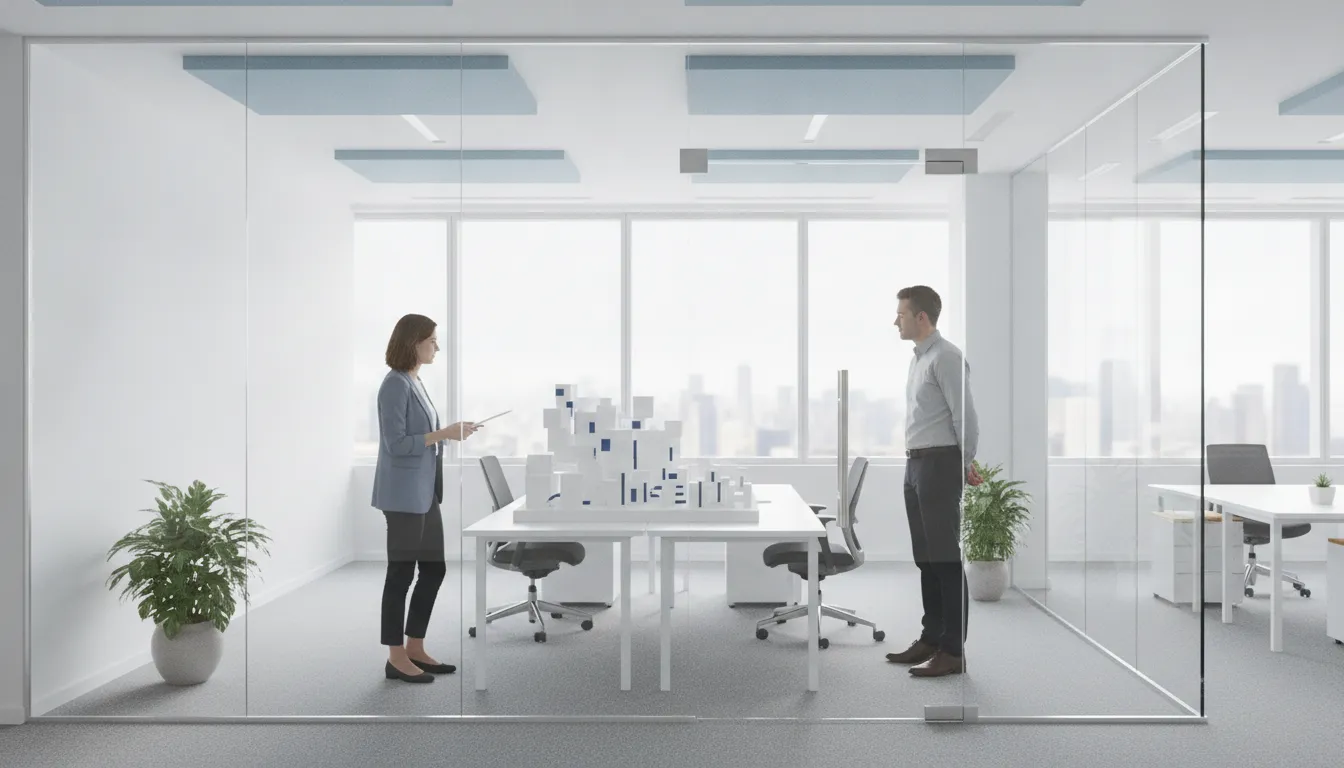
Glass can separate two areas without making them acoustically separate. A meeting may feel visually enclosed while nearby speech remains audible, because speech privacy depends on the whole room and sound path, not just the transparent pane.
Planning a glass partition? Contact Glass Rescue IGWT to request a free estimate for your project.
In general, are glass partitions soundproof? No: a glass partition should not be assumed to create total silence or confidential speech privacy. How much sound carries depends on the complete assembly, including doors, framing, edge seals, and paths around or above it, as well as background noise and room furnishings. Visual privacy and acoustic privacy are different; a frosted surface can obscure a view without changing those sound paths.
It also helps to separate sound transmission between rooms from echo within a room. Research on transparent partitions describes reflected voices as a source of distraction, even when the partition itself is not the only route sound travels. Understanding these differences makes it easier to set realistic expectations for an office or home layout.
Are glass partitions soundproof, or do they only reduce noise?
Glass partitions are not automatically soundproof. Depending on the full assembly and how it meets the surrounding space, they may reduce some sound transmission. But voices can still be heard on the other side. “Soundproof” suggests a level of isolation that cannot be assumed from the presence of glass alone.
It helps to separate two acoustic effects. Sound transmission is speech or other noise passing from one space into another through or around a partition. Echo and reverberation happen when sound reflects within a room. A barrier can affect the first, while reflective surfaces can make the second more noticeable. Research on transparent partitions describes reflected voices as a possible source of conversation disturbance and reduced speech privacy (study of transparent partition reflections).
Speech privacy is also different from visual privacy. A clear pane may block a direct view only if it is treated or positioned to do so, and even an opaque surface does not necessarily stop speech. Whether a conversation can be understood depends on factors beyond the partition material, including background noise. The level of speech, the amount of shared partition area, and furnishings in both rooms, according to MIT-hosted office acoustics guidance.
That is why no general glass partition should be treated as a guaranteed acoustic barrier. The rating of a tested partition applies to its assembly, not simply the glass pane; doors and other components matter too. Installed conditions may also differ from laboratory test conditions.
For a meeting room, home office, or other space where people need to talk privately. Set expectations based on the intended use and complete design rather than appearance alone.
Finally, reducing room echo is not the same as blocking sound between rooms. Reflective glass may contribute to voices bouncing around a space; sound-absorbing surfaces can help address that reflection. But they do not by themselves establish how much sound crosses the partition. The right question is not just whether the wall is glass, but which sound problem needs to be addressed.
| Acoustic concern | What to review | Why it matters |
|---|---|---|
| Sound through the barrier | Glass, frame, doors, and tested assembly | The rating applies to the complete assembly, not glass alone. |
| Sound around the barrier | Perimeter joints, floor, ceiling, and shared openings | Gaps and flanking paths can bypass the pane. |
| Echo within a room | Hard surfaces and absorptive furnishings | Room treatments may reduce reflections but do not guarantee isolation. |
What affects sound transfer through a glass partition?
Sound performance depends on the complete partition, not just the pane. An STC (Sound Transmission Class) rating describes the tested assembly, including doors and other components, rather than a sheet of glass in isolation. The Canadian Building Digest on office acoustics notes that small air leaks can sharply reduce performance.
Comparing a glass specification alone may not predict how much speech carries into the next room. Consider each part of the barrier and the surrounding construction together.
Glass can vibrate when sound energy strikes it, and the amount transmitted depends in part on the amplitude of that vibration. A historic U.S. Bureau of Standards discussion of sound transmission identifies glass mass, stiffness, and how it is clamped as relevant factors. Pane thickness or construction therefore cannot be considered apart from how the glass is supported. These are general acoustic principles, not a performance rating for a particular project or a claim that any specific glass option is offered.
Framing and mounting affect how the pane meets the floor, ceiling, and adjacent walls. A perimeter that is not sealed continuously can leave a path for sound to pass around the glass. The MIT-hosted guidance notes that even a narrow unsealed crack can undermine an otherwise stronger partition. A door adds another part to the assembly: the door leaf, frame, threshold, and edge seals all influence whether the closed opening behaves like the surrounding partition. An open gap is especially important because sound can pass through it instead of being limited by the glass.
Lab results also depend on the test setup. In the laboratory, the partition is carefully fitted into an opening and small perimeter gaps are sealed. A real installation may have different junctions, adjacent construction, or site conditions, so its result can differ if those details do not match the tested assembly. The practical question is how the entire specified system, including its installation and doors, is expected to perform in the actual space.
When reviewing glass partition wall options, discuss the room layout, door locations, framing, and perimeter details together. Glass Rescue IGWT does not publish a verified STC rating or acoustic guarantee here. Request project-specific information rather than assuming a laboratory number applies to an installed partition.
Can sound travel over, under, or around the glass?
Yes. Sound does not always stop at the visible edge of a partition. Even when the glass itself reduces some direct sound, voices may take a flanking path through the building around it. The ceiling plenum is one example: in an office with a shared space above the ceiling, sound can travel up from one room and back down into another. A partition that stops at a suspended ceiling may therefore leave a route around the barrier. The MIT-hosted building acoustics digest describes this ceiling-plenum path and distinguishes ceiling attenuation from a wall’s STC rating. Those measurements are not interchangeable.
Sound can also pass through or around adjoining construction. If a partition ends at carpet rather than connecting to the floor beneath it, or does not meet adjacent walls appropriately, sound may bypass the divider. Perimeter joints matter too. Small unsealed gaps at the head, base, sides, or around a door can offer sound an easier route than the solid assembly. The MIT guidance recommends continuous construction and sealed perimeter joints. It also notes that real installations may not match carefully sealed laboratory test edges. These are general building-acoustics principles, not a performance guarantee for a particular glass product.
Openings and building services deserve attention as part of the room layout. A door left open creates a direct path, while shared openings or ducts may connect spaces in ways the glass line alone does not reveal. These routes are different from sound passing through the glass, so replacing a pane would not necessarily address them. For a project where speech privacy matters, consider the whole boundary and what continues above, below, and beside it.
There is another issue that can be mistaken for sound traveling through a partition: reflection. Transparent, hard surfaces can bounce speech back into a room or toward other listeners. A study of transparent partitions describes reflected voices as a source of conversation disturbance and notes sound-absorbing material as one possible way to address that acoustic problem. Reflection can make a room feel louder or conversations less comfortable, but it is not the same mechanism as transmission through a barrier. Absorbing sound in the room may reduce reflections; it does not automatically seal a flanking path or block sound reaching the next room.
In short, track the complete route, not just the pane. The MIT-hosted acoustics digest explains flanking paths and installation limits, while the transparent-partition study discusses reflections and acoustic comfort.
What should offices and homes realistically expect?
A glass partition can define a space and preserve openness, but it does not promise confidential conversations. In an office, speech privacy depends on background noise, how loudly people speak, the shared area of the boundary, and furnishings. The Canadian Building Digest’s office acoustics guidance describes privacy as the result of these combined conditions, not the partition material alone.
That difference matters for meeting rooms, consultation spaces, and offices where people discuss sensitive information. A conversation may remain audible even when the glass reduces some sound transmission. Open routes around the partition, adjoining spaces, and the ceiling can also affect what people hear. If speech confidentiality is important, discuss the room’s actual use and the complete installed boundary with the project team rather than relying on appearance or a product label.
A quiet office with occasional conversations has different demands from a busy shared workspace where several people speak at once. Consider whether the goal is simply to reduce distraction or to keep particular conversations from being understood. Those are not the same expectation.
At home, the expectation may be different. A glass divider between a kitchen and living area can separate activities visually while allowing household sounds and conversation to carry between them. That may suit everyday use, but it is not the same as creating a quiet bedroom, work area, or private room. Consider who will use each space, when noise is most likely, and whether doors, adjacent rooms, and the ceiling leave sound paths open. A layout that works for casual separation may not work for focused work or private calls.
Also distinguish echo control from blocking sound. Rugs, curtains, upholstered furniture, and other absorptive furnishings can soften reflections within a room and make conversation feel less harsh. They do not necessarily prevent sound from passing through a partition or around its edges. Research on transparent partitions notes that reflected voices can disturb conversations. The study identifies sound-absorbing material as one possible response, but this concerns room acoustics, not a guarantee of isolation (study of transparent partitions and sound absorption).
When asking whether glass partitions are soundproof, clarify whether the goal is less echo, visual separation, reduced sound transfer, or speech privacy. These outcomes are not interchangeable. Review glass wall dividers for offices as a starting point, then assess the specific space and its privacy needs before selecting a design.
What should you ask an installer about acoustic privacy?
Before choosing a layout, describe what you need the space to do. A partition that preserves light and visual openness may not provide the speech privacy a meeting room or home office needs. Use these questions to clarify the design and what can realistically be confirmed for your project.
-
What does privacy mean for this room? Explain whether you want to soften everyday conversation, reduce distraction, or keep confidential speech from being understood next door. Ask how room size, background noise, furnishings, and the amount of shared partition area affect that goal. These factors influence speech privacy alongside the partition itself, as described in guidance on office speech privacy.
-
Where could sound travel around the glass? Ask the installer to review the full route, not just the pane: edges, joints, the top of the partition, door openings, and connections to adjacent walls. Small unsealed gaps can undermine an otherwise solid barrier, so ask how each perimeter detail will be addressed. The same guidance notes that sound may bypass a partition through alternative paths when it is not properly joined to surrounding construction.
-
What are the glass, frame, and connection details? Ask what glass configuration, framing or mounting method, and joint details are proposed, and how those choices relate to your privacy goal. Sound transmission through glass depends in part on its vibration, with mass, stiffness, and how it is clamped among the relevant factors, according to this Bureau of Standards discussion of sound and glass.
-
What happens at the shared ceiling and floor? Ask whether the partition stops at a suspended ceiling or continues to the structure above, and whether sound could travel through a shared ceiling space. Ask how the base will meet the floor and surrounding construction. A partition’s performance may be affected by these paths even if the glass itself is unchanged.
-
What evidence applies to this exact complete assembly? If a rating or test result is discussed, ask for the documentation and confirm it covers the proposed glass, frame, door, seals, and connections as a system. A laboratory result is not automatically a prediction of an installed partition; ask whether the real installation matches the tested conditions.
-
What limitations or tradeoffs should I expect? Ask what conversations may remain audible, which openings or design choices affect privacy, and whether the goals conflict with access, openness, or the desired appearance. Glass Rescue’s general guide to frameless partition types and benefits can help you compare design approaches, but it is not an acoustic rating or performance promise.
For a project-specific discussion, contact Glass Rescue IGWT to request a free estimate. Share the intended use, layout, and privacy concerns so the team can understand the scope. Acoustic performance should be confirmed for the proposed system rather than assumed.
Frequently Asked Questions
Is glass good for soundproofing?
Glass can be part of a partition that reduces some sound transfer, but a glass divider should not be assumed to make a room soundproof. The result depends on the full assembly, including its edges, doors, gaps, and nearby construction. For Glass Rescue IGWT projects, ask what evidence applies to the specific installed system; the company does not publish acoustic ratings or soundproofing guarantees.
What is the best material to block sound?
There is no single best material for every room. Sound control depends on how the complete boundary is designed and sealed, as well as the sound path and the privacy needed. The MIT-hosted Canadian Building Digest explains that an assembly’s sound rating includes doors and other components, not just the wall material (source). Compare complete, relevant systems rather than choosing by material name alone.
What are the disadvantages of glass partition walls?
Glass provides visual openness, so it offers less visual privacy than an opaque wall unless the design includes an appropriate privacy treatment. It can also reflect voices, which may make conversations distracting in a lively space. And sound may pass through openings or travel around the partition, so the result may not suit a room that needs confidential speech privacy. Consider both the room’s layout and how it will be used.
Can adding soft furnishings make a glass partition quieter?
Soft furnishings or sound-absorbing surfaces can help reduce reflections and echo inside a room, making it feel less reverberant. That is different from stopping sound from passing into the next space. If speech privacy matters, ask about the partition, doors, perimeter details, ceiling, and other possible sound paths as one system.
Ready to plan a glass partition?
Discussing the room layout and the level of privacy you need can help make the project estimate specific to your space. Contact Glass Rescue IGWT to request a free estimate for glass partition design and installation. Share how the area will be used and any questions about the opening, doors, or surrounding construction so the team can understand the project you have in mind.