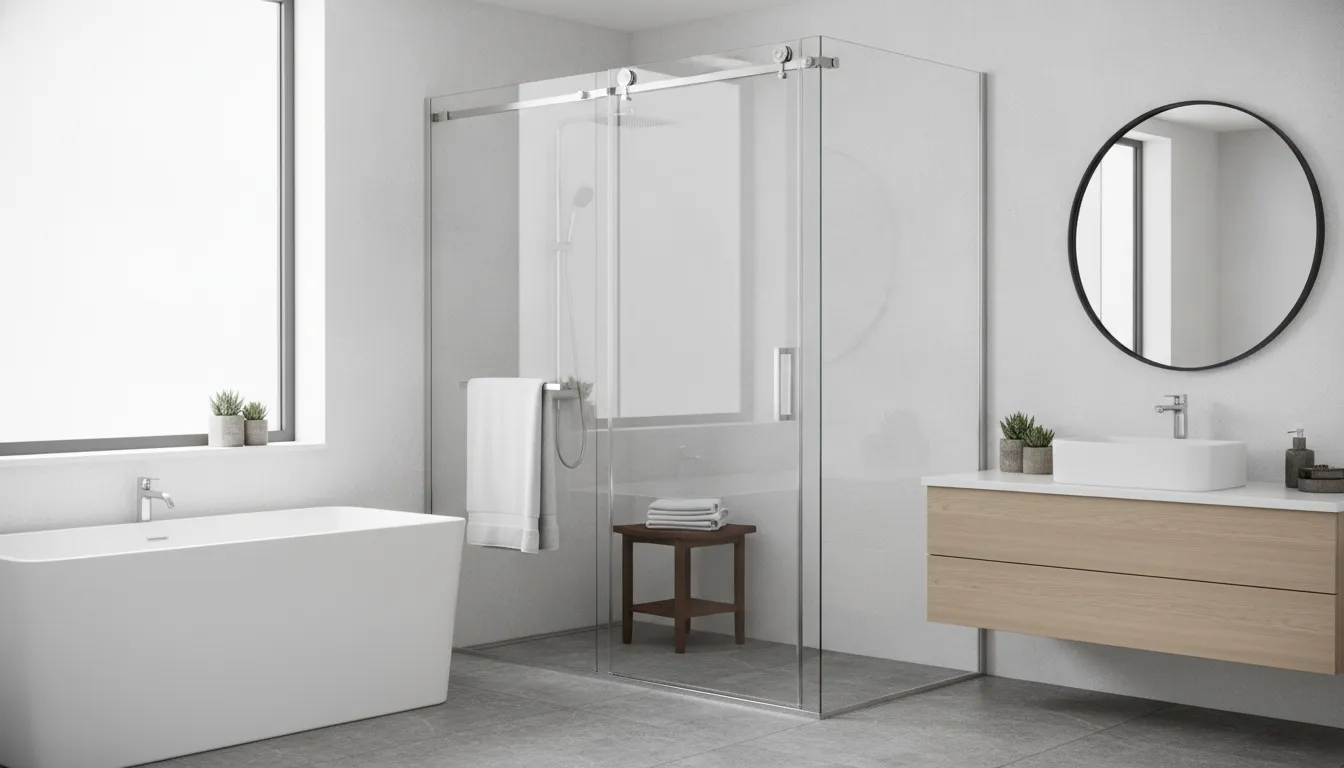
A well-designed shower enclosure should look good, contain water, and work smoothly every day. Sliding glass shower doors can meet those goals when the door style, glass, hardware, and measurements match the bathroom. They are especially useful in compact layouts because the panels move from side to side rather than requiring swing clearance. You can choose from framed, semi-frameless, and frameless designs, along with clear, frosted, textured, or fluted glass. However, appearance is only part of the decision. Proper alignment, solid wall support, quality rollers, and a correctly sloped threshold all play an important role in safety and performance.
Key Takeaways
- Match the door to the space: Review wall clearance, opening width, panel overlap, nearby fixtures, entry width, and curb slope before selecting a sliding design.
- Invest in a proper installation: Professional measuring, secure wall support, precise track alignment, safe glass handling, and leak testing help protect the enclosure’s performance and longevity.
- Compare the complete system: Evaluate tempered glass, rollers, tracks, seals, hardware finishes, privacy, accessibility, maintenance needs, warranties, and replacement parts before approving a quote.
What Are Sliding Glass Shower Doors?
Sliding glass shower doors, also called bypass shower doors, use two or more glass panels that move along a track. One panel slides behind or in front of the other, creating an opening without requiring the door to swing into the bathroom. This space-saving design makes them a practical choice for bathrooms with limited floor area or fixtures positioned close to the shower.
Unlike a shower curtain, glass doors create a defined enclosure while keeping the room feeling open. Clear glass allows light to pass through and can make a compact bathroom feel more spacious. Frosted, textured, or patterned glass offers more privacy. Frames, hardware, handles, and glass thickness also influence the door’s appearance, durability, and cleaning requirements.
A sliding door installation requires careful measurements. The walls, curb, threshold, and shower opening all affect how the panels should be fitted. Even a small alignment problem can cause uneven gaps, sticking, leaks, or unnecessary strain on the rollers. A professional shower glass installation can help ensure the door fits the enclosure and operates smoothly.
How Bypass Doors Work
A typical bypass shower door has two glass panels mounted on parallel tracks. Both panels may slide, although some designs use one moving panel and one fixed panel. When you open the door, the panels overlap instead of swinging outward. This lets you enter the shower without reserving floor space beside the enclosure.
The track supports the panels, while rollers allow them to move from side to side. Bottom guides help keep the glass stable, and anti-jump features can help prevent a panel from lifting out of the track. The track and mounting brackets must be square and level. If the opening is misaligned, the panels may develop uneven gaps or fail to close properly.
Quality rollers, guides, seals, and hardware all contribute to reliable operation. Installation guidance also emphasizes checking whether the glass channel and mounting brackets are square when gaps or alignment problems appear. A professional can assess the opening before ordering the door and recommend components suited to the enclosure. Review Glass Rescue’s glass services when planning a custom installation.
Compare Sliding and Hinged Doors
Sliding doors are often a practical choice for smaller bathrooms because they do not need clearance outside the shower. You can position a vanity, toilet, or other fixture closer to the enclosure without blocking the door’s path. They also work well when the shower opening is wide enough to accommodate overlapping panels.
Hinged or pivot doors open outward or inward on hinges. They typically provide a wider entry because the door can span much of the shower opening. This may be useful for accessibility, larger showers, or anyone who prefers a more open entry. However, the bathroom must have enough space for the door to swing safely without hitting a fixture, wall, or person.
Sliding doors have a few tradeoffs. Their tracks need regular cleaning, and the usable entry may be narrower than that of a hinged door. Still, their compact footprint and clean appearance make them popular in many bathroom layouts. A glass professional can compare both styles based on your measurements, shower design, and household needs through a custom glass consultation.
Check Wall Space, Opening Width, and Clearance
Before selecting a sliding glass shower door, measure the entire shower opening rather than only the area where the panels will sit. Record the width at the top, middle, and bottom, then measure the height on both sides. Differences between these measurements may indicate that the walls, curb, or threshold are out of square.
Check the wall space beside the opening as well. Sliding panels need room to travel along the track, and towel bars, shelves, grab bars, plumbing fixtures, or decorative trim may interfere with movement. Make sure the finished entry will be wide enough for comfortable access after accounting for panel overlap.
The curb or threshold also affects water containment. It should direct water toward the drain rather than the bathroom floor. An inward slope of about 1/8 inch per foot is commonly recommended, although the installer should assess the existing curb and drainage conditions. If the curb is damaged, uneven, or poorly sloped, it may need attention before the door is installed.
Use Them in Residential and Commercial Bathrooms
Sliding glass shower doors suit many residential bathrooms, including primary suites, guest bathrooms, apartments, rental properties, and compact condos. They provide a defined, durable enclosure without taking up the floor space required by a swinging door. With the right glass and hardware finish, the same basic design can complement a traditional renovation or a contemporary bathroom.
These doors can also work in commercial settings such as hotels, apartment buildings, assisted living facilities, gyms, and other properties with multiple bathrooms. Commercial projects may require extra attention to hardware durability, cleaning routines, privacy, accessibility, and replacement parts. High-use bathrooms benefit from components designed to withstand frequent opening, closing, and cleaning.
The right design depends on how people will use the space, how often it will be cleaned, and whether it needs added privacy or accessibility features. Glass Rescue serves residential and commercial customers across Dade and Broward counties, including Hollywood, with service expanding into Hillsborough County. Its team can help plan a sliding glass shower solution around your property and project requirements.
Why Choose Sliding Glass Shower Doors?
Sliding glass shower doors combine practical performance with a clean, modern appearance. Instead of swinging into the bathroom, the panels glide along a track. This design works well in compact bathrooms, narrow layouts, and larger showers where you want to preserve an open feel.
A sliding door can also make daily use more comfortable, but the installation must be planned carefully. The opening needs enough wall space for the panels to overlap, while the track, rollers, seals, and guides must be properly aligned. Glass Rescue provides custom glass shower door services for residential and commercial projects, with solutions designed around each bathroom’s layout, style, and needs.
Save Space
Sliding glass shower doors do not need the floor clearance required by hinged doors. Since the panels move along a track, you can place the shower closer to a vanity, toilet, towel bar, or other fixture without worrying about the door swinging into it.
This space-saving design is particularly useful in smaller bathrooms, where every inch matters. It can also provide more flexibility during a renovation or bathroom layout change. Instead of leaving a large area open in front of the shower, you can use that space for storage, movement, or another fixture.
Keep in mind that a sliding door still needs sufficient wall space. The panels must have room to overlap and glide without hitting nearby walls or fixtures. Measure the shower opening and the surrounding area before choosing a system. VIGO’s sliding shower doors provide examples of how bypass doors can make efficient use of limited space.
Create a Modern, Open Look
Glass shower doors allow natural and artificial light to pass through the enclosure, helping the bathroom feel brighter and more spacious. Clear glass is a popular choice when you want to display tilework, a decorative shower niche, or other design details.
Frameless sliding doors offer a particularly open appearance because they use minimal metal around the glass. Semi-frameless and framed options provide more visible structure and may suit bathrooms that need additional support or a more traditional look. The best choice depends on the opening, wall conditions, bathroom style, and installation requirements.
You can personalize the enclosure with clear, frosted, textured, or fluted glass. Hardware finishes such as chrome, brushed nickel, and matte black offer additional design options. Matching the hardware to your faucets, cabinet pulls, lighting, and other fixtures can give the bathroom a more coordinated appearance.
Improve Daily Access
A sliding door provides convenient access without requiring a wide opening area. One panel moves along the track, allowing you to enter the shower without stepping around a swinging door. This can be helpful in busy family bathrooms, guest bathrooms, and commercial spaces.
The design is also useful when a hinged door would interfere with the bathroom layout. You do not have to keep the entire area in front of the shower clear, and the door is less likely to hit nearby fixtures or furniture.
Smooth operation depends on the quality and condition of the rollers, track, and guides. Dirt, misalignment, or worn components can cause the door to stick, drag, or wobble. Regular cleaning and prompt repairs can help prevent small issues from becoming more serious. If the panel becomes difficult to move, avoid forcing it, since excess pressure can damage the rollers or other hardware.
Contain Water Without Swing Clearance
Sliding shower doors help define the shower entrance while using less space outside the enclosure. Overlapping panels, bottom guides, and properly fitted seals work together to direct water back toward the shower area. This makes sliding doors a practical choice for bathrooms with limited clearance.
Water containment also depends on the shower’s construction and installation. The curb should slope toward the drain, the glass panels must be aligned correctly, and the sweeps or seals should sit securely in place. A problem with any of these details may allow water to escape onto the bathroom floor.
A professional site assessment can identify issues with the shower base, wall conditions, opening width, and drainage before installation begins. Tile Redi’s sliding door systems illustrate how sliding doors and fixed panels can create a defined enclosure without the clearance required by a swinging door.
Consider Tracks, Overlap, and Cleaning Access
Tracks and rollers are essential to a sliding door’s performance, so inspect these features before making a purchase. Ask how much the panels overlap, how the rollers are supported, and whether the track is easy to reach for routine cleaning.
Soap residue, hair, and hard-water deposits can collect along the bottom track. Over time, this buildup may affect how smoothly the rollers move. A narrow or enclosed track can look streamlined but may take more effort to clean. An accessible track can make regular maintenance easier, especially in a bathroom used by several people.
Choose a system with smooth rollers, secure bottom guides, and anti-jump features that help keep the panels in place. Professional installation is equally important. As Schicker Shower Doors notes, poor installation can contribute to leaks, misalignment, and safety concerns. Accurate measurements and careful fitting help the door operate reliably and remain easier to maintain.
Which Sliding Glass Shower Door Fits Your Space?
The right sliding glass shower door should fit your bathroom’s layout, daily routine, and design style. Start by looking at the shower opening, the amount of wall space available for the track, and the clearance around nearby fixtures. A compact bathroom may work best with a two-panel bypass door, while a wider primary shower may benefit from a sliding door paired with a fixed panel.
Think about how the shower will be used, too. A private primary bathroom may suit clear glass, while a shared bathroom, guest suite, or commercial facility may need frosted or textured glass. Accessibility, privacy, cleaning, and long-term hardware performance are just as important as appearance.
The condition of the opening can also affect your choice. Uneven walls, out-of-square corners, unusual dimensions, or an older shower enclosure may require custom glass instead of a standard door. Glass Rescue provides custom shower glass services for residential and commercial properties in Dade County, Broward County, Hollywood, Tampa, and surrounding areas.
Compare Framed, Semi-Frameless, and Frameless Styles
Framed sliding doors have metal around the edges of the glass panels. This frame adds structure and protects the glass edges, making framed doors a practical choice for many standard shower openings. They also have a traditional appearance and may cost less than frameless designs.
Semi-frameless doors use metal framing in select areas while leaving more glass exposed. They offer a cleaner appearance with some added support. Frameless doors use minimal hardware for a modern, open look. They typically require thicker glass, precise measurements, and careful installation because the glass carries more of the enclosure’s visual presence. Review the differences between framed, semi-frameless, and frameless shower doors before selecting a style.
Choose Two-Panel Bypass Doors
Two-panel bypass doors are a practical choice for smaller bathrooms. The panels slide past one another instead of swinging into the room, so the door does not need outward clearance. This leaves more usable floor space around the shower and allows nearby fixtures, such as a vanity or toilet, to sit closer to the enclosure.
A bypass design also gives you flexibility because either panel can usually slide open. Remember that the entry opening will be narrower than the enclosure’s total width because one panel overlaps the other. Ask your installer to confirm the usable entry width before ordering, especially if the shower must accommodate mobility equipment or a wider, easier-access entry.
Pair Sliding Doors With Fixed Panels
A sliding door with a fixed glass panel can create a wider enclosure without requiring a swinging door. The fixed panel stays in place and adds stability, while the sliding panel provides an entry point. This combination can work well when the shower opening is too wide for a standard two-panel bypass door.
Fixed panels can also give the enclosure a more open, custom appearance. With minimal framing, the design keeps sightlines clear and allows decorative tile to remain visible. The panel placement should account for the showerhead, curb, and areas most likely to receive water. See how sliding doors with fixed panels combine access and stability in a wider enclosure.
Select Clear, Frosted, Textured, or Fluted Glass
Clear glass creates the most open appearance and lets you show off tile, fixtures, and built-in shelving. It can help a smaller bathroom feel brighter and less enclosed, but it provides the least privacy. Clear glass is often a good fit for a primary bathroom where the shower interior is part of the overall design.
Frosted, obscure, rain, smoke gray, textured, and fluted glass offer more privacy while still allowing light through. Patterns may also make water spots and fingerprints less noticeable than they are on completely clear glass. Ask to see samples before making a decision, since texture and opacity can look different under bathroom lighting. A glass professional can help you compare privacy, maintenance, and appearance together.
Consider Matte Black and Industrial Hardware
Matte black hardware creates a noticeable contrast against clear glass, white tile, and neutral walls. It suits modern, minimalist, industrial, and farmhouse-inspired bathrooms. Black handles, rollers, tracks, and brackets can coordinate with faucets, cabinet pulls, lighting, and towel bars.
Dark hardware also draws attention, so it is best to repeat the finish elsewhere in the room. In areas with hard water, mineral residue may stand out on matte surfaces. Drying the hardware after use and cleaning it with a mild product can help maintain its appearance. Glass Rescue can help you compare shower door glass and hardware options for a coordinated installation.
Choose Chrome, Brushed Nickel, or Other Finishes
Chrome and stainless steel are versatile choices that work with a wide range of tile colors and bathroom styles. Their reflective surfaces can add brightness and pair naturally with polished plumbing fixtures. Brushed nickel has a softer look and often suits warm gray, beige, transitional, and traditional interiors.
Other finishes may include matte black, matte brushed gold, and specialty metallic tones. Consider maintenance as well as appearance. Brushed finishes can disguise light fingerprints, while polished finishes may need more frequent wiping to retain their shine. For a consistent design, match the shower finish with the faucet, sink fixtures, cabinet hardware, and other visible metal elements. VIGO’s sliding shower door finishes include several options for different bathroom styles.
Address Privacy, Accessibility, and Commercial Needs
A bathroom’s purpose should guide the glass and door design. Frosted or patterned glass can provide greater privacy in a shared bathroom, guest suite, rental property, or commercial facility. Clear glass may be more appropriate for a private primary bathroom where an open appearance matters most.
Accessibility requires planning before fabrication. A wider opening, low threshold, easy-grip handle, and smooth door movement can make entry and exit easier. The layout should also leave enough room for safe approach and maneuvering. Commercial bathrooms may need durable hardware, easy-to-clean surfaces, and components designed for frequent use. Glass Rescue handles residential and commercial glass projects, including shower enclosures and other custom glass installations.
Select Reversible Door Directions
Many sliding shower doors can be installed with the opening on the left or right. This reversible design helps you work around a vanity, toilet, wall, towel bar, or other fixture. It can also make one door configuration suitable for several bathroom layouts.
Before installation, identify the most convenient entry side. Check where the handle will sit, whether the open panel will interfere with a fixture, and how the door relates to the bathroom’s main walkway. A reversible door may have limits when paired with certain fixed panels, hardware, or custom layouts. Confirm the door direction, panel arrangement, track position, and usable entry width with your installer before the glass is fabricated.
Which Features Should You Compare?
A sliding glass shower door may look straightforward, but several details affect its fit, safety, appearance, and day-to-day performance. Comparing these features before you buy can help you avoid problems such as doors that drag, loose hardware, difficult-to-clean tracks, and gaps that allow water to escape.
Start with the opening dimensions and glass specifications. Then review the track system, rollers, seals, hardware, finish, and warranty. A door that looks ideal in a product photo may not work well with your bathroom’s curb, wall structure, or available clearance. This matters even more in commercial bathrooms, where the door may be opened and closed many times each day.
Professional measurement and installation can also prevent costly mistakes. Glass Rescue provides custom glass shower door services for residential and commercial properties throughout Dade County, Broward County, Hollywood, Tampa, and surrounding service areas. An experienced installer can identify fit and support concerns before the glass is ordered, then recommend a door that suits the space.
Compare Width, Height, Overlap, and Custom Sizing
Start by comparing the door’s finished width and height with your shower opening. Sliding doors need sufficient panel overlap to reduce water from escaping through the center gap, while still providing comfortable access when one panel is open. The opening width may also determine whether a two-panel bypass system is practical.
Standard sizes can work well in newer bathrooms, but many openings are not perfectly uniform. Tiled walls, older construction, and remodeling work can create small differences from one side to the other. Ask whether the door includes adjustment space and whether custom sizing is available. If the opening is unusually wide, tall, or shallow, a made-to-order enclosure may provide a cleaner fit than a standard kit. Confirm the actual finished dimensions, not just the advertised size.
Measure Out-of-Square Openings Professionally
A shower opening is out of square when the walls are not perfectly parallel or the corners do not meet at exact right angles. Even a small variation can affect how the panels sit, how the rollers move, and whether the seals make consistent contact.
Measure the width at the top, middle, and bottom of the opening, then check whether both walls are plumb. The smallest measurement often matters most when determining whether a door will fit. You should also inspect the curb or threshold for slope, level, and usable depth. Since tempered glass must be ordered to precise dimensions, professional measurement is a smart step before placing an order. Glass Rescue’s contact team can evaluate your opening and recommend an appropriate design.
Choose 1/4-Inch or 3/8-Inch Tempered Glass
Sliding shower doors commonly use 1/4-inch or 3/8-inch tempered glass. Both options can work well when properly designed and installed, but they create a different look and feel. Thicker glass often feels more substantial and may complement a minimalist frameless or semi-frameless enclosure.
Tempered glass is treated to improve its resistance to thermal stress and impact compared with ordinary glass. If it breaks, it is designed to fracture into smaller pieces rather than large, sharp shards. The Consumer Product Safety Commission’s safety glazing guidance explains why safety glazing is important in areas where people may come into contact with glass. Your installer can recommend a thickness based on the panel size, support system, hardware, and enclosure design.
Compare Aluminum Frames and Stainless Steel Hardware
Framed sliding doors often use aluminum around the glass, while semi-frameless and frameless systems rely more heavily on clips, channels, rollers, handles, and other hardware. Aluminum frames can provide structure and help protect the glass edges. Stainless steel hardware offers a clean appearance and strong resistance to corrosion when properly maintained.
Look beyond the finish color. Ask about the material grade, hardware construction, roller quality, and how each component attaches to the wall and glass. In a humid bathroom, low-quality metal or poorly protected finishes may discolor, pit, or corrode over time. Common finishes include chrome, brushed nickel, matte black, and oil-rubbed bronze. Choose hardware that complements your fixtures and fits the cleaning routine you can realistically maintain.
Look for Smooth Rollers, Bottom Guides, and Anti-Jump Stops
The roller system controls how the door feels each time you open or close it. Quality rollers should move smoothly along the track without excessive noise, sticking, or side-to-side movement. A bottom guide helps keep the panels aligned, especially when the doors are used frequently.
Anti-jump stops are another useful safety feature. They help prevent a sliding panel from lifting out of the upper track during normal operation. Ask how the rollers and guides can be reached for cleaning or replacement, since hair, soap residue, and mineral deposits can collect inside the track. A well-designed system should feel stable without requiring excessive force. If the door requires pushing, catches at one point, or wobbles during operation, the track or rollers may not be properly adjusted.
Consider Adjustable Tracks and Soft-Close Features
Adjustable tracks can accommodate minor variations in wall position and opening width. They do not replace accurate measurement, but they give the installer some flexibility during final alignment. Ask how much adjustment the system provides and whether that range is enough for your bathroom’s opening.
Soft-close hardware gradually slows the door near the end of its travel, reducing slamming and stress on the rollers and frame. This feature can be useful in family bathrooms, guest suites, and commercial properties where the door may be used repeatedly. Soft-close systems generally cost more than basic hardware, so compare the feature with your priorities, expected usage, and budget. Also ask whether the soft-close mechanism can be serviced or replaced if it stops working.
Select Handles, Sweeps, Seals, and Drip Rails
Small components have a major effect on daily performance. Handles should be comfortable to grip and securely attached. A properly fitted bottom sweep can reduce splashing beneath the door, while side seals help close the gaps between moving and fixed panels.
Drip rails may direct water back toward the shower instead of allowing it to run onto the bathroom floor. These parts should match the door design and be replaceable when they become brittle, cracked, or worn. Ask which replacement seals and sweeps are available before purchasing. A door can remain structurally sound while its flexible components need periodic replacement, so accessible parts are worth considering from the start. Confirm that the seals will not interfere with the door’s movement.
Consider Water-Repellent, Easy-Clean Glass
Clear glass keeps a bathroom feeling open, but it can show water spots, soap film, and mineral buildup. A factory-applied water-repellent coating may help droplets slide off more easily and make routine cleaning less demanding. However, no coating eliminates maintenance. You will still need to remove residue regularly and follow the manufacturer’s care instructions.
Ask whether the coating is applied at the factory, how long it is covered by the warranty, and which cleaners are approved. Do not assume that a coating makes the glass scratch-proof or stain-proof. A quick squeegee after each shower, combined with regular cleaning, usually does more for the enclosure’s appearance than relying on a coating alone. If your home has hard water, discuss glass treatments and cleaning expectations with the installer before choosing a finish.
Check Safety Standards, Edge Protection, and Quality
Confirm that the glass is safety-rated for shower enclosure use and that the finished product meets applicable building requirements. Tempered glass should not be drilled, cut, or modified after tempering because those changes can compromise the panel. Ask how the glass edges are finished and protected during transport and installation.
Inspect the overall quality before installation. The panels should be free from visible damage, the hardware should fit securely, and the track should not arrive bent or poorly finished. Professional installers also check that the glass is supported correctly and that the door does not place unnecessary stress on the walls or curb. For more information about Glass Rescue’s experience and services, visit the company’s About Us page.
Compare Standard and Custom-Fitted Doors
Standard sliding doors can be practical when the opening matches the product’s approved size range. They are often quicker to order and may cost less than a fully custom system. Before choosing one, verify the exact width range, height, adjustment allowance, glass thickness, and hardware configuration. Make sure the listed dimensions match the finished opening rather than the rough framing.
Custom-fitted doors are better suited to unusual dimensions, uneven walls, large openings, low curbs, or designs that require a specific glass pattern and finish. Custom work may involve more planning and a longer production period, but it can provide a better fit and a more cohesive appearance. Ask for a written description of what is included, including measurement, fabrication, delivery, installation, and any required wall preparation. This makes it easier to compare quotes accurately.
Review Warranties, Replacement Parts, and Installer Support
A warranty can show how the manufacturer stands behind the glass, hardware, finish, rollers, and seals. Read the terms carefully because coverage may differ between residential and commercial installations. Some warranties cover manufacturing defects but exclude damage caused by improper cleaning, installation, modification, or normal wear.
Also ask how replacement parts are handled. Rollers, guides, sweeps, seals, and handles may eventually need service even when the glass remains in excellent condition. A reliable installer should explain maintenance needs, identify the parts used, and provide support if the door develops alignment or operating problems. When comparing local providers, consider the quality of the consultation and follow-up service, not only the initial quote. Clear communication before installation can make future repairs much simpler.
How Much Do Sliding Glass Shower Doors Cost?
Sliding glass shower doors can cost anywhere from several hundred dollars for a basic, door-only model to several thousand dollars for a custom, professionally installed enclosure. The final price depends on more than the glass. Door size, glass thickness, frame style, hardware, finish, site conditions, delivery, and installation all play a part.
A standard sliding door may work well for a bathroom with a level curb and straight, properly finished walls. However, unusual dimensions, an out-of-square opening, a fixed glass panel, or specialty glass may require custom fabrication. These details can increase the price, but they can also help the finished enclosure fit more securely and look more polished.
Online product listings can help you create an initial budget. Keep in mind that listed prices often cover the product only, not measuring, removal, preparation, delivery, or installation. Ask for a detailed estimate based on your actual bathroom opening before making a decision. Glass Rescue provides custom glass shower door services for residential and commercial properties in Dade, Broward, Hollywood, Tampa, and surrounding areas.
Compare Door-Only and Installed Pricing
Door-only pricing generally covers the glass panels, track system, rollers, handles, and basic hardware. Retail listings for sliding shower doors range from approximately $405 to $1,280 after discounts, with some products listed near $1,375. These prices are useful for setting a starting budget, but they do not necessarily reflect the full cost of completing your project.
Professional installation includes more than attaching the door to the wall. Labor may cover precise leveling, track alignment, sealing, panel adjustment, and leak testing. Removal and disposal of an existing enclosure, delivery, and repairs to the opening may cost extra. Ask each contractor to separate product, labor, delivery, removal, and preparation charges. This makes it easier to compare estimates fairly and understand what your glass installation quote includes.
See How Size and Glass Thickness Affect Cost
Larger sliding doors typically cost more because they require additional glass and stronger support components. Listed prices for sliding doors with fixed panels range from approximately $975 to $1,500 for a 47-inch model, $1,140 to $1,556 for a 59-inch model, and $1,634 to $1,800 for a 71-inch model. The exact price can change based on the glass, hardware, finish, and configuration.
Glass thickness can affect both product and installation costs. Thicker tempered glass weighs more and may require heavier tracks, reinforced hardware, and additional care during handling. Your installer should recommend a suitable thickness based on the opening size, panel dimensions, wall support, and door style. Choosing the thinnest option may reduce the initial price, but the complete system still needs to provide the stability and performance your bathroom requires.
Compare Framed, Semi-Frameless, and Frameless Prices
Framed sliding doors use metal around the glass panels and along the edges. They can provide a practical, structured design and often have a lower starting price than frameless systems. However, frames create additional channels and edges where soap residue, moisture, and mineral deposits may collect, so regular cleaning is important.
Semi-frameless doors use less metal while retaining framing or support in key areas. Frameless doors use minimal hardware and leave more glass exposed, creating a clean, open appearance. They often cost more because they require heavier glass, precise measurements, stronger hardware, and careful installation. A frameless shower door may be a good option when you want a modern look and a custom fit, particularly in a remodeled bathroom with carefully finished walls.
Account for Specialty Glass and Hardware Finishes
Clear glass is often the most economical choice, while frosted, textured, fluted, tinted, and patterned glass may increase the price. Specialty glass can provide more privacy or support a particular design, but availability and fabrication requirements vary. Before selecting a pattern, ask whether it is regularly stocked, made to order, or associated with a longer production time.
Hardware finishes also affect the overall cost and appearance. Common options include chrome, stainless steel, brushed nickel, matte black, and brushed gold. Matte black works well with contemporary fixtures, while chrome and brushed nickel suit a wide range of bathroom styles. Coordinate the track, handles, brackets, and other visible components so the enclosure looks cohesive. A finish that matches your faucets and lighting can make the installation feel more intentional without requiring a full bathroom renovation.
Consider Custom Measurements and Made-to-Order Designs
Stock sliding doors are made for common opening sizes, but many bathrooms do not have perfectly straight walls or level curbs. Custom measurements may be necessary when the opening is unusually wide, the walls are out of square, or the design includes a fixed glass panel. Made-to-order doors can also accommodate specific heights, glass patterns, handle styles, and hardware finishes.
Custom fabrication generally costs more than an off-the-shelf door, but it can reduce fitting problems and create a cleaner finished result. The opening should be measured at multiple points, and the installer should confirm the sliding direction, panel overlap, curb slope, and available clearance before ordering. Glass Rescue can discuss custom glass solutions based on your bathroom layout, preferred style, and installation conditions.
Include Removal, Preparation, and Delivery Costs
Replacing an existing enclosure may involve more work than installing a door in a new opening. Ask whether the estimate includes removal and disposal. Old doors can have corroded fasteners, damaged tracks, cracked caulk, or moisture damage hidden behind the frame. Careful removal helps protect surrounding tile and gives the installer an opportunity to inspect the opening.
Preparation may include repairing tile, reinforcing a wall, correcting an uneven curb, or adjusting the threshold. Large or custom-fabricated panels may also require special delivery and additional handling. These services are important because a poorly installed shower door can lead to leaks, misalignment, or safety concerns. Review these shower door installation guidelines and confirm every preparation, delivery, and disposal charge before approving the work.
Compare Residential and Commercial Pricing
Residential projects often involve one enclosure, a standard bathroom layout, and a smaller selection of hardware. Commercial installations may include multiple openings, larger panels, privacy glass, reinforced hardware, or scheduling requirements that work around employees, tenants, and customers. These factors can increase labor, coordination, delivery, and installation costs.
Commercial bathrooms also need materials that can withstand frequent use. Durable tracks, reliable rollers, easy-to-clean glass, and replaceable seals may provide better long-term value than the least expensive system. When requesting a commercial estimate, provide the number of openings, approximate dimensions, building access details, preferred installation schedule, and any privacy or accessibility requirements. Clear project information helps the installer plan labor and materials more accurately.
Evaluate Local Quotes, Promotions, and Long-Term Value
An advertised price may apply only to a standard door and exclude installation, custom sizing, delivery, removal, or preparation. Promotions may also have product-specific terms. Some retailers advertise free shipping while excluding particular door collections or custom products. Read the details and compare the complete installed price instead of focusing on a single discount.
Request two or three local estimates that list the same features, including dimensions, glass thickness, frame style, hardware finish, warranty, and installation scope. A local glass professional can account for the actual condition of your bathroom and explain which upgrades are useful for your space. Consider the quality of the rollers, tracks, seals, and hardware, as replacing low-quality parts can cost more over time.
Glass Rescue has more than two decades of experience with residential and commercial glass projects. Review Glass Rescue’s service options, then request a project-specific quote that reflects your opening, preferred design, and installation needs.
What Does Sliding Glass Shower Door Installation Require?
Installing a sliding glass shower door involves more than attaching a track and hanging two panels. The process starts with evaluating the bathroom opening, wall support, curb, drainage, and available clearance. The installer must then select compatible hardware, handle heavy tempered glass safely, align the panels, and seal the enclosure against water.
Accurate installation affects the door’s safety, appearance, and everyday performance. Incorrect measurements or weak mounting surfaces can cause wobbling, sticking, leaks, and premature hardware damage. As Glass Rescue’s shower glass services demonstrate, custom glass work requires careful attention to the layout and details of each enclosure.
Schedule a Professional Site Assessment
Before ordering a sliding glass shower door, schedule an on-site assessment. A glass professional will measure the opening, check whether the walls are plumb, and identify obstacles such as trim, faucets, shelves, and uneven tile. These measurements help determine whether a standard door will fit or whether the enclosure requires custom fabrication.
The assessment should also cover the door direction, panel overlap, handle position, and available clearance. Planning these details before fabrication can prevent costly changes later. A professional can also identify conditions that may lead to leaks, cracks, or unstable doors if they are overlooked. Shower installation guidance emphasizes the value of measuring and planning the layout before work begins.
Check Wall Support and Substrate Conditions
Sliding shower door hardware must attach to a solid, stable surface. Before drilling, the installer should check the wall framing, tile, backer board, and other substrate materials. Tile alone may not provide enough support for a top track or fixed panel, particularly when the system uses thick glass and substantial metal hardware.
If the walls are out of square or the substrate is damaged, the design or installation plan may need to change. In some cases, preparation work should happen before the glass arrives. Mounting hardware into a weak surface can leave the track loose and allow the panels to shift over time. Confirming wall support early helps protect the glass, hardware, and surrounding tile.
Confirm Curb Slope, Drainage, and Water Containment
The shower curb and threshold should direct water toward the drain rather than toward the bathroom floor. A slight inward slope, commonly around 1/8 inch per foot, helps keep water inside the enclosure. The installer should also inspect the drain location, threshold, door sweep, and bottom guide before positioning the panels.
Water containment depends on the entire system, not just the glass. Panel overlap, seals, drip rails, guides, and the relationship between the door and curb all matter. If the curb is poorly sloped or the door leaves excessive gaps, water may escape even when the glass itself is correctly installed. Reviewing common shower installation mistakes can help clarify why drainage should be addressed before fitting the door.
Handle Heavy Tempered Glass Safely
Sliding shower doors commonly use tempered safety glass, which is durable but can still break when its edges or corners strike a hard surface. The panels may also be heavy and difficult to control in a confined bathroom. Safe handling requires the right equipment, enough trained help, and a clear path from the delivery area to the shower.
Installers should protect the glass during transport and avoid placing pressure on corners, edges, or drilled openings. They must also follow the manufacturer’s instructions when setting panels into the track and guides. Because tempered glass cannot be cut or drilled after manufacturing, an incorrect measurement or damaged panel may require replacement rather than adjustment.
Align Tracks, Rollers, and Panels
The top track, bottom guide, rollers, and glass panels must sit squarely for the door to move correctly. Even a small alignment problem can create uneven gaps, friction, or a panel that shifts as it opens. The installer should level the track, position the rollers evenly, and confirm that the panels overlap as planned.
Rollers should carry the panels smoothly without dragging or rocking. Bottom guides help keep the doors centered and reduce side-to-side movement. If the fixed panel or track is not square, the door may wobble or leave inconsistent gaps. Frameless sliding door troubleshooting highlights how channel and bracket alignment can affect the final fit.
Seal Gaps and Test for Leaks
After the panels and hardware are aligned, the installer seals the appropriate joints around the track, wall connections, fixed panels, and threshold. Sealant must be applied in the correct locations. Blocking a drainage path or sealing an area that needs to release water can create additional problems.
Once the sealant has cured according to the product instructions, the enclosure should be tested with running water. The installer can check the corners, bottom edge, panel overlap, and wall connections for drips or spray escaping the shower. This test may reveal a misplaced sweep, excessive gap, or drainage issue before the bathroom returns to regular use. These shower door installation recommendations explain why proper sealing is important for preventing leaks and safety concerns.
Fix Sticking, Dragging, Wobbling, and Misalignment
A properly installed sliding door should open and close smoothly without scraping the track or shifting from side to side. Sticking or dragging may indicate misaligned rollers, debris in the track, an uneven threshold, or a bent component. Wobbling can point to a loose guide, an unsecured panel, or hardware that needs adjustment.
Avoid forcing a door that feels stuck. Extra pressure can damage the rollers, track, seals, or glass edges. A technician can inspect the system, tighten the hardware, reposition the rollers, and correct the alignment. If the issue appeared immediately after installation, contact the installer before attempting adjustments. Early service may prevent a small hardware problem from causing further damage.
Repair Rollers, Tracks, and Drainage Problems
Rollers can wear down with use, while tracks and bottom guides can collect soap residue, mineral buildup, and debris. Some systems allow individual parts to be replaced without removing the entire enclosure. A repair professional should match replacement rollers, guides, seals, and stops to the existing door system.
Track damage or drainage problems may require more than a new replacement part. A bent track, deteriorated substrate, or poorly sloped curb can continue causing trouble after new rollers are installed. A technician should inspect the complete enclosure before recommending a repair. Common problems include offline rollers, stuck doors, bent tracks, and broken rollers, each of which can affect smooth operation and water containment.
Compare DIY and Professional Installation
DIY installation may seem manageable, but it requires precise measurements, specialty tools, safe glass handling, and a clear understanding of the hardware system. A small mistake can leave the door unstable, create leaks, or damage a tempered panel that cannot be cut or modified after manufacturing.
Professional installation is especially helpful when the opening is out of square, the glass is heavy, the walls need additional support, or the design includes fixed panels and custom hardware. An experienced installer can manage measurement, fitting, adjustment, sealing, and final testing as one process. Before hiring a company, ask about its experience, glass and hardware quality, warranty coverage, and included preparation work. To discuss a residential or commercial project, contact Glass Rescue for service in Dade, Broward, Hollywood, Tampa, and surrounding areas.
How Do You Clean, Maintain, and Repair Sliding Glass Shower Doors?
Sliding glass shower doors need regular care to stay clear, secure, and easy to operate. Water spots and soap scum can dull the glass, while hair, dirt, and mineral deposits can collect inside the track. If left untreated, this buildup may cause the panels to drag, wobble, or stop closing properly.
A few simple habits make routine maintenance much easier. Squeegee the glass after each shower, clean the enclosure weekly, and dry the tracks and hardware after washing them. You should also inspect the seals, rollers, handles, and guides every few weeks so you can address small problems before they affect the entire door.
Always use products that are safe for your glass, tile, stone, metal, and protective coatings. If the enclosure includes natural stone, specialty hardware, or a custom finish, check the manufacturer’s care instructions before applying a cleaner. Glass Rescue’s shower glass services can also help when cleaning no longer solves a performance or safety issue.
Never attempt to cut, drill, or modify tempered shower glass. If you notice a crack, chip, unstable panel, or major hardware failure, stop using the door and arrange a professional inspection.
Squeegee Glass After Every Shower
Use a clean squeegee on the inside of each glass panel after every shower. Start at the top and pull downward in overlapping strokes. Wipe the blade as needed, then use a soft microfiber cloth to dry the bottom edge, corners, seals, and area where the panels overlap.
This quick step removes water before it dries and leaves behind mineral spots or soap residue. Pay close attention to the lower corners, where moisture often remains after the rest of the glass looks dry.
Keep the squeegee inside the shower so it is easy to reach. Daily drying will not replace weekly cleaning, but it can reduce the amount of scrubbing your glass and hardware need.
Clean Weekly With Safe Products
Clean the glass, handles, seals, and tracks at least once a week with a mild, non-abrasive bathroom cleaner. Apply the product to a soft cloth or sponge instead of spraying heavily around the rollers and other moving parts. Excess moisture can collect inside the hardware and contribute to corrosion or poor movement.
Rinse the glass thoroughly after cleaning, then dry it with a microfiber towel. Leftover cleaner may leave a cloudy film, especially when it mixes with hard water. Check the product label to confirm that it is safe for glass, metal, stone, and any protective coating on your enclosure.
A consistent weekly routine is safer and easier than waiting until thick buildup requires aggressive scrubbing.
Remove Hard-Water Spots and Soap Scum
Hard-water deposits often appear as cloudy spots, white film, or rough patches on the glass. Soap scum may look greasy or dull and usually gathers along the bottom edge of the door. For light buildup, apply a glass-safe cleaner and let it sit for the time listed on the label before wiping with a soft cloth.
A diluted solution of equal parts white vinegar and water may help loosen mineral residue on untreated glass. Apply it with a cloth, allow it to work briefly, and rinse the surface thoroughly. Do not use a razor blade, scouring pad, or abrasive powder to scrape away deposits. These tools can scratch the glass or damage nearby finishes.
If gentle cleaning does not remove the buildup, ask a glass professional about safe cleaning methods or protective treatments.
Use Vinegar Carefully Around Stone and Metal
Vinegar can loosen mineral deposits, but its acidity may damage some bathroom materials. Do not allow it to sit on marble, limestone, travertine, or other natural stone. Acid can etch these surfaces and leave a dull mark that regular cleaning will not remove.
Vinegar may also affect certain metal finishes, sealants, and hardware coatings. Before using it, test the diluted solution in a hidden area and check the care instructions for your shower materials. Keep the solution on the glass rather than allowing it to run onto the curb, wall, frame, or track.
If your enclosure includes stone tile or specialty hardware, choose a cleaner approved for those surfaces. When you are unsure, a professional can recommend products that are suitable for the complete shower enclosure.
Avoid Abrasive Cleaners, Harsh Chemicals, and Rough Tools
Avoid scouring powders, steel wool, rough brushes, and abrasive cleaning pads. These products can leave fine scratches on the glass and damage protective coatings, seals, or metal finishes. Scratches may become more visible over time and cannot always be removed.
Do not mix cleaning chemicals, particularly products that contain bleach, ammonia, or acids. Open a window or run the exhaust fan while cleaning, and follow every instruction on the product label. A soft microfiber cloth, non-abrasive sponge, and mild cleaner are usually sufficient for routine care.
Use gentle pressure instead of scrubbing harder. If residue does not come off easily, allow an appropriate cleaner to loosen it first. Persistent stains, etched glass, and damaged coatings may require professional assessment rather than stronger chemicals.
Clean Tracks, Rollers, Guides, and Thresholds
Dirt, hair, and soap residue can collect inside the bottom track, around the rollers, and in the door guide. This buildup may eventually make the panels stick, wobble, or drag. Vacuum loose debris first, then wipe the track with a soft cloth and mild cleaner. A small, soft brush can reach corners without scratching the finish.
Rinse away cleaner carefully and dry the track to limit corrosion. Check the threshold for standing water and clear any debris from drainage gaps. Never force a door that feels stuck because pressure can damage the rollers or pull hardware out of alignment.
If cleaning does not restore smooth movement, the rollers or track may be worn. Use Glass Rescue’s contact page to arrange an inspection for repair or replacement.
Improve Ventilation to Limit Moisture and Mold
Good ventilation helps the shower dry faster and limits moisture around the glass, walls, seals, and tracks. Run the bathroom exhaust fan during your shower and for a while afterward. If the room remains damp, open a window when practical or use a dehumidifier.
Wipe standing water from the threshold and nearby surfaces, especially in a bathroom used several times a day. Check corners, caulk lines, and the bottom of the door for dark spots or persistent dampness. Drying these areas regularly can help limit mildew and unpleasant odors.
The Environmental Protection Agency’s mold guidance recommends moisture control as an important part of mold prevention. If mold keeps returning or appears behind walls and caulk, arrange an appropriate professional evaluation.
Inspect Seals, Sweeps, Handles, Rollers, and Hardware
Look over the enclosure every few weeks for loose screws, worn seals, cracked sweeps, noisy rollers, and gaps around the panels. The bottom sweep should sit correctly against the threshold without folding, tearing, or dragging. A damaged seal can let water escape and leave the bathroom floor wet after each shower.
Check that the handles feel secure and that the panels remain stable as they slide. Never continue using a door that shifts sharply, comes off its guide, or makes a grinding sound. These signs may point to a roller, track, or support problem.
Tightening an accessible fastener or replacing a worn sweep may be straightforward when the correct part is available. Work involving heavy glass and mounted support hardware should be handled by an experienced technician.
Use Approved Care and Lubrication Products
Use only cleaning products and lubricants recommended for your specific rollers, tracks, seals, and hardware. Household oils can attract dust, collect soap residue, or damage rubber and plastic components. They may also leave the track slippery without addressing the reason the door is sticking.
Before applying any product, remove dirt and dry the track. Use a small amount only where the manufacturer permits it. Keep lubricant off the glass, threshold, and bathroom floor, and wipe away excess immediately.
If the door still sticks after cleaning and approved care, do not keep adding lubricant. The rollers may be worn, the track may be bent, or the panels may need realignment. A professional inspection can identify the cause and prevent further damage.
Repair Worn Parts or Replace the Door
Minor issues, such as a loose handle screw or worn bottom sweep, may be suitable for careful repair when the correct replacement part is available. Follow the hardware manufacturer’s instructions, and do not remove components that support or hold a glass panel in place.
Cracks, chips, deep scratches, shattered glass, severe corrosion, and doors that repeatedly come off their tracks require professional attention. Tempered glass should not be drilled, cut, or modified after installation. Stop using the enclosure if a panel appears damaged or unstable.
A technician may be able to repair the rollers, guides, seals, or track. In other cases, replacing the door may provide a safer and more reliable result. Glass Rescue’s installation and glass solutions can help you determine the right option for your bathroom.
Choose Custom Sliding Glass Shower Doors From Glass Rescue
A sliding glass shower door should fit your bathroom, rather than forcing the space to accommodate a standard product. Wall angles, opening dimensions, curb size, tile layout, and hardware placement all affect the finished enclosure. A custom design gives you more control over these details while creating a comfortable, polished space for everyday use.
Glass Rescue works with homeowners, contractors, property managers, and business owners on residential and commercial glass projects. Our shower glass services can support a bathroom remodel, new construction project, or high-use commercial installation.
Professional planning also helps prevent common problems, including uneven gaps, sticking panels, leaks, and loose hardware. Accurate measurements and careful installation are especially important when the walls are uneven or the shower opening is out of square. Before choosing a design, review these shower door installation tips to understand which site conditions can affect the final result.
Find Custom Residential Shower Solutions
Every bathroom has a different layout, from compact guest baths to spacious primary suites with wide shower openings. A custom sliding door can be sized around the available wall space, curb, and surrounding fixtures while complementing the room’s design.
Glass Rescue can help you compare framed, semi-frameless, and frameless styles, along with different glass patterns and hardware finishes. Clear glass keeps the room feeling open, while frosted, textured, or fluted glass can offer more privacy. Your design should also account for handle placement, door overlap, cleaning access, and the direction each panel slides.
The best enclosure balances appearance with practical daily use. Instead of choosing a door based only on its style, consider how it will work with your bathroom layout, household routines, and maintenance preferences. Explore our residential glass solutions to learn more about custom options for your home.
Plan Commercial and High-Traffic Installations
Commercial bathrooms need shower doors that can handle frequent use while remaining simple to operate and maintain. Hotels, apartment communities, gyms, assisted living facilities, and other properties may require multiple enclosures with consistent dimensions, hardware, and finishes.
Glass Rescue can help coordinate the glass installation with your broader construction or renovation schedule. Planning may include reviewing opening dimensions, selecting durable hardware, allowing access for maintenance, and confirming that the design supports employees, residents, guests, or customers.
High-traffic spaces also benefit from straightforward cleaning routines and replacement parts that are easy to source. A carefully installed enclosure can help reduce issues such as loose tracks, misaligned panels, and water escaping through poorly sealed areas. When planning a commercial project, consider both the appearance of the finished bathrooms and the demands placed on each enclosure. Visit our commercial glass services to explore solutions for business properties.
Rely on More Than Two Decades of Experience
Glass shower installation involves more than carrying a door into place and attaching a few brackets. Installers must account for uneven walls, tiled surfaces, curb slopes, hardware positions, and the weight of tempered glass. Small errors can affect how a panel rolls, closes, and contains water.
Glass Rescue brings more than two decades of experience to residential and commercial glass projects. Our team has handled work ranging from residential glass installations to commercial storefronts and partition walls. That experience supports a careful approach to measurements, materials, alignment, and finish quality.
Professional support can also simplify the process when an existing bathroom presents challenges. Experienced installers can identify conditions that may require preparation before installation begins, helping prevent avoidable changes later. Learn more about our background and approach on the Glass Rescue About Us page.
Get Precise Measurements and Installation Support
Accurate measurements are the foundation of a well-fitting sliding shower door. An installer should review the opening width and height at multiple points, check whether the walls are plumb, and inspect whether the curb is level and slopes toward the drain. These details affect panel size, track placement, door movement, and water containment.
An out-of-square opening may require design adjustments or a different installation method. The mounting surface also needs enough support for the selected glass and hardware. A professional site assessment helps identify these conditions before the door is ordered, reducing the risk of delays or costly changes.
During installation, the panels, guides, rollers, and tracks must be aligned carefully. The installer should test the door for smooth movement and inspect seals and gaps. Installation guidance recommends checking that channels and brackets are square when panels appear uneven or misaligned. To discuss an assessment, contact Glass Rescue with your project details.
Choose Quality Glass, Hardware, and Finishes
The glass is only one part of a sliding shower door system. Rollers, tracks, guides, handles, seals, brackets, and finishes all affect the enclosure’s appearance and performance. Compatible, well-made components can help the door operate smoothly and remain attractive with regular care.
Tempered safety glass is commonly used for shower enclosures because it is designed for this type of application. You can compare clear, privacy, and decorative glass based on the amount of light and visibility you prefer. Hardware finishes such as chrome, brushed nickel, and matte black can coordinate with faucets, cabinet pulls, lighting, and towel bars.
Your installer can also explain features such as water-repellent glass, bottom guides, anti-jump stops, soft-close hardware, and replacement parts. These details may affect the project price, but they also influence daily convenience and long-term maintenance. Glass Rescue can help you select materials that suit your design preferences and the demands of your bathroom.
Serve Dade, Broward, Hollywood, and Tampa-Area Customers
Glass Rescue serves residential and commercial customers across Dade County, Broward County, Hollywood, and the Tampa area. Whether you are replacing an outdated enclosure or planning glass for a new bathroom, local service makes it easier to coordinate measurements, installation, and follow-up support.
Florida properties can have very different access and construction conditions. A condo bathroom may present different requirements than a single-family home. A hotel, gym, or apartment community may need a larger installation plan with consistent finishes across several bathrooms.
Our team works with clients to understand the property, intended use, and design goals before recommending a solution. To confirm availability in your area, review the Glass Rescue contact information. Sharing your city, project type, and preferred timeline can help us provide more useful guidance.
Expand Service Into Hillsborough County
Glass Rescue is expanding into Hillsborough County, including communities in and around Tampa. This expansion gives more homeowners, builders, contractors, and commercial property owners access to custom glass services from an experienced team.
If you are planning a sliding glass shower door in Hillsborough County, begin by sharing the project location and scope. New construction, bathroom remodeling, replacement work, and multi-unit installations may each require a different approach. Photos, rough dimensions, and information about the existing shower can help determine the next steps.
Service availability may depend on project details, property access, and scheduling requirements. Contact Glass Rescue early if your installation is part of a larger renovation. Measurements and glass fabrication may need to coordinate with tile, plumbing, waterproofing, and other trades. Review our glass services to see how we can support your project.
Prepare Measurements, Photos, and Project Details
You do not need to complete a professional measurement before contacting Glass Rescue, but a few details can make the first conversation more productive. Note the approximate opening width and height, the shower location, and whether an existing door needs to be removed.
Photos are also helpful. Take clear images of the full shower opening, curb, walls, ceiling, floor, nearby fixtures, and any areas that appear damaged or uneven. Include close-ups of the current hardware, tracks, seals, and tile. If you have a preferred glass style or hardware finish, include that information too.
Also share the property type, city, desired installation date, and whether the project involves new construction or replacement work. If water currently escapes from the enclosure, explain where the problem occurs. These details help the team prepare for an informed consultation instead of relying on a single measurement.
Schedule a Sliding Glass Shower Door Consultation
A consultation gives you an opportunity to discuss the space, compare design options, and identify installation requirements before selecting a door. Glass Rescue can review your goals, explain available configurations, and help you choose glass and hardware that suit the bathroom.
During the consultation, ask about custom sizing, glass thickness, track and roller systems, water containment, installation timing, warranties, and replacement parts. It is also a good time to discuss privacy, accessibility, cleaning, and frequent-use requirements.
To get started, contact Glass Rescue with your location and project details. Whether you are updating one residential bathroom or planning a larger commercial installation, a clear conversation at the beginning can help keep the project organized from measurement through installation.
Frequently Asked Questions
Are sliding glass shower doors a good choice for small bathrooms?
Yes. Sliding doors move along a track instead of swinging into the room, so they need less floor clearance. They work well near vanities, toilets, and other fixtures, but the shower opening must provide enough width for panel overlap and comfortable entry.
What type of glass is best for a sliding shower door?
Clear glass creates an open appearance and highlights tilework, while frosted, textured, or fluted glass provides greater privacy. Tempered safety glass is commonly used for shower enclosures. The ideal thickness depends on the panel size, support system, hardware, and overall door design.
How do I know whether I need a custom sliding shower door?
Custom sizing may be necessary if the walls are uneven, the opening is out of square, the curb is unusually shaped, or the enclosure includes a fixed panel. Measure the opening at several points, but have a glass professional verify the space before ordering, since tempered glass cannot be cut after fabrication.
How much maintenance do sliding glass shower doors require?
Wipe the glass with a squeegee after each shower and clean the panels, hardware, seals, and tracks regularly with approved, non-abrasive products. Remove hair and residue from the track so the rollers can move freely. Avoid harsh chemicals and rough tools that may damage the glass or finish.
When should I call a professional for sliding shower door repair?
Contact a professional if the door sticks, drags, wobbles, leaks, comes off its guide, or makes grinding noises. Cracks, chips, loose panels, damaged tracks, and severe corrosion also require prompt attention. Do not force the door or attempt to cut, drill, or modify the glass.